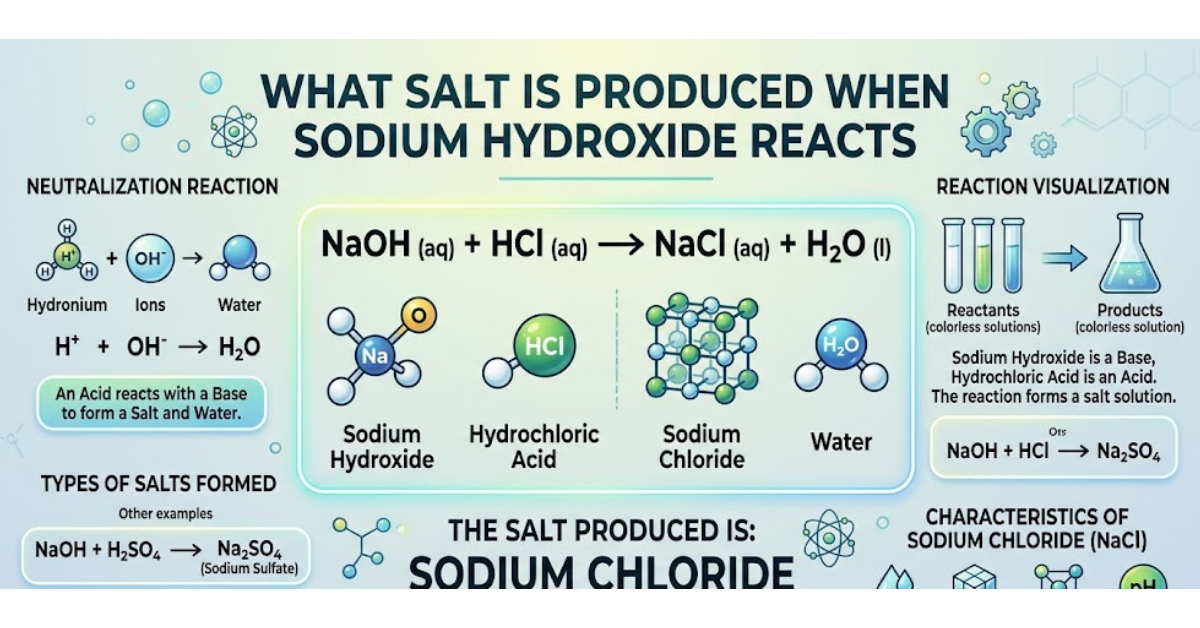
Have you ever wondered what happens when a strong acid and a strong base are mixed together? This classic chemistry reaction is one of the first examples students encounter when learning about neutralization.
If you’re asking, what salt is produced when sodium hydroxide reacts with sulfuric acid?, the short answer is sodium sulfate (Na₂SO₄). Along with water, sodium sulfate is the primary product of this neutralization reaction. Understanding why this happens requires a closer look at the chemistry behind acids, bases, and salts.
In this guide, you’ll learn the balanced chemical equation, how the reaction works, why sodium sulfate forms, and where this reaction is used in laboratories and industry.
The Simple Answer
When sodium hydroxide (NaOH) reacts completely with sulfuric acid (H₂SO₄), the salt produced is:
Sodium sulfate (Na₂SO₄)
At the same time, water (H₂O) is also formed.
Balanced Chemical Equation
2NaOH+H2SO4→Na2SO4+2H2O\mathbf{2NaOH + H_2SO_4 \rightarrow Na_2SO_4 + 2H_2O}
This equation shows that:
- Two moles of sodium hydroxide react with one mole of sulfuric acid.
- One mole of sodium sulfate is produced.
- Two moles of water are formed.
Understanding the Reactants
Before examining the products, it’s helpful to know what each reactant contributes.
Sodium Hydroxide (NaOH)
Sodium hydroxide, commonly called caustic soda, is a strong base.
Properties include:
- Highly alkaline
- Completely dissociates in water
- Produces hydroxide ions (OH⁻)
- Widely used in soap making, paper manufacturing, and cleaning products
Sulfuric Acid (H₂SO₄)
Sulfuric acid is one of the strongest and most important industrial acids.
Characteristics include:
- Strong acid
- Highly corrosive
- Releases hydrogen ions (H⁺) in solution
- Used in fertilizers, batteries, and chemical manufacturing
Because sulfuric acid contains two acidic hydrogen ions, it requires two sodium hydroxide molecules for complete neutralization.
Why Is Sodium Sulfate Produced?
The answer lies in the process of acid-base neutralization.
During the reaction:
- Sodium hydroxide supplies Na⁺ and OH⁻ ions.
- Sulfuric acid supplies H⁺ and SO₄²⁻ ions.
The ions rearrange:
- Hydrogen ions combine with hydroxide ions to form water.
- Sodium ions combine with sulfate ions to form sodium sulfate.
The simplified ionic reactions are:
H⁺ + OH⁻ → H₂O
2Na⁺ + SO₄²⁻ → Na₂SO₄
This exchange of ions is what creates the final products.
What Type of Reaction Is This?
The reaction belongs to several important categories in chemistry.
Neutralization Reaction
An acid reacts with a base to produce:
- Salt
- Water
This is the textbook definition of neutralization.
Double Displacement Reaction
The positively charged ions switch partners.
Originally:
- NaOH
- H₂SO₄
After reaction:
- Na₂SO₄
- H₂O
Because ions exchange places, this is also known as a double replacement reaction.
What Is Sodium Sulfate?
Sodium sulfate is an inorganic salt with the chemical formula:
Na₂SO₄
It is usually found as:
- White crystalline solid
- Odorless
- Highly soluble in water
- Chemically stable
Unlike sodium hydroxide or sulfuric acid, sodium sulfate is relatively safe to handle under normal conditions.
Properties of Sodium Sulfate
Some important characteristics include:
| Property | Value |
| Chemical formula | Na₂SO₄ |
| Common name | Sodium sulfate |
| Appearance | White crystals |
| Solubility | Soluble in water |
| Nature | Neutral salt |
| Molar mass | 142.04 g/mol |
These properties make sodium sulfate useful in many industrial processes.
Why Does the Equation Need Two Sodium Hydroxide Molecules?
This is one of the most common questions students ask.
Sulfuric acid is a diprotic acid, meaning each molecule contains two hydrogen ions that can react.
Each sodium hydroxide molecule neutralizes one hydrogen ion.
Therefore:
- 1 sulfuric acid molecule
- requires
- 2 sodium hydroxide molecules
That is why the balanced equation is:
2NaOH + H₂SO₄ → Na₂SO₄ + 2H₂O
Balancing the equation ensures that the number of atoms is the same on both sides.
Can Another Salt Be Produced?
Yes—but only under specific conditions.
If sodium hydroxide is not present in sufficient quantity, the reaction may stop halfway.
Instead of sodium sulfate, the product becomes:
Sodium hydrogen sulfate (NaHSO₄)
Equation:
NaOH + H₂SO₄ → NaHSO₄ + H₂O
This is known as partial neutralization.
When enough sodium hydroxide is added, the reaction continues until sodium sulfate forms.
Step-by-Step Explanation of the Reaction
Let’s break the reaction into simple steps.
Step 1: Dissociation
In water:
NaOH → Na⁺ + OH⁻
H₂SO₄ → 2H⁺ +SO₄²⁻
Step 2: Neutralization
Hydrogen ions meet hydroxide ions.
H⁺ + OH⁻ → H₂O
Water is formed.
Step 3: Salt Formation
Remaining ions combine.
2Na⁺ + SO₄²⁻ → Na₂SO₄
This forms sodium sulfate.
Final Products
- Sodium sulfate
- Water
No acid or base remains if the reaction occurs in the correct proportions.
Real-World Applications of This Reaction
Although it is commonly taught in school chemistry, this reaction also has practical uses.
Laboratory Experiments
Students use this reaction to learn:
- Neutralization
- Stoichiometry
- Ionic equations
- pH changes
Chemical Manufacturing
Industries use similar neutralization reactions to:
- Produce salts
- Remove excess acids
- Prepare chemical solutions
Wastewater Treatment
Acidic waste streams can be neutralized using sodium hydroxide before disposal.
This helps:
- Protect the environment
- Prevent corrosion
- Meet regulatory standards
Industrial Salt Production
Sodium sulfate is used in manufacturing:
- Detergents
- Glass
- Textiles
- Kraft paper
- Certain pharmaceutical products
Is Sodium Sulfate Acidic, Basic, or Neutral?
Sodium sulfate is generally considered a neutral salt.
This is because it forms from:
- A strong acid (sulfuric acid)
- A strong base (sodium hydroxide)
Solutions of sodium sulfate usually have a pH close to 7, although slight variations can occur depending on concentration and temperature.
Common Mistakes Students Make
Here are a few misconceptions to avoid.
Confusing Sodium Sulfate with Sodium Sulfite
These are different compounds.
- Sodium sulfate = Na₂SO₄
- Sodium sulfite = Na₂SO₃
Only sodium sulfate forms from sulfuric acid.
Forgetting to Balance the Equation
Many students incorrectly write:
NaOH + H₂SO₄ → Na₂SO₄ + H₂O
This equation is not balanced.
The correct equation is:
2NaOH + H₂SO₄ → Na₂SO₄ + 2H₂O
Assuming All Reactions Produce the Same Salt
Different acids produce different salts.
For example:
- Hydrochloric acid → Sodium chloride
- Nitric acid → Sodium nitrate
- Sulfuric acid → Sodium sulfate
Practical Tips for Remembering the Reaction
Here are a few easy ways to remember it:
- Sulfuric acid always contributes the sulfate (SO₄²⁻) ion.
- Sodium hydroxide always contributes the sodium (Na⁺) ion.
- Salt names combine the metal and the acid’s negative ion: Sodium + Sulfate = Sodium Sulfate.
- Diprotic acids like sulfuric acid require two hydroxide ions for complete neutralization.
These simple patterns can help you solve similar chemistry questions more confidently.
Key Takeaways
- Sodium hydroxide reacts with sulfuric acid in a neutralization reaction.
- The salt produced is sodium sulfate (Na₂SO₄).
- Water is also formed during the reaction.
- The balanced equation is 2NaOH + H₂SO₄ → Na₂SO₄ + 2H₂O.
- Sulfuric acid is diprotic, so it needs two sodium hydroxide molecules for complete neutralization.
- If the reaction is incomplete, sodium hydrogen sulfate (NaHSO₄) may form instead.
Frequently Asked Questions
What salt is produced when sodium hydroxide reacts with sulfuric acid?
The salt produced is sodium sulfate (Na₂SO₄) when sodium hydroxide completely neutralizes sulfuric acid. Water is also formed as a byproduct.
Why are two sodium hydroxide molecules needed?
Sulfuric acid contains two acidic hydrogen ions. Each sodium hydroxide molecule neutralizes one hydrogen ion, so two molecules are required for complete neutralization.
What happens if there is not enough sodium hydroxide?
If insufficient sodium hydroxide is present, the reaction may produce sodium hydrogen sulfate (NaHSO₄) instead of sodium sulfate. This is known as partial neutralization.
Is sodium sulfate a neutral salt?
Yes. Sodium sulfate is generally considered a neutral salt because it is formed from a strong acid and a strong base, resulting in a solution with a pH close to neutral.
What type of reaction occurs between sodium hydroxide and sulfuric acid?
This is both a neutralization reaction and a double displacement (double replacement) reaction. The acid and base exchange ions to produce salt and water.
Where is sodium sulfate used?
Sodium sulfate is used in the production of detergents, glass, textiles, paper, and various chemical processes. It also serves as a drying agent in some laboratory applications.
Conclusion
So, what salt is produced when sodium hydroxide reacts with sulfuric acid? The answer is sodium sulfate (Na₂SO₄). This classic acid-base neutralization reaction also produces water and demonstrates fundamental concepts such as ion exchange, stoichiometry, and chemical balancing. Whether you’re studying chemistry for school, preparing for an exam, or simply expanding your scientific knowledge, understanding this reaction provides a solid foundation for learning how acids and bases behave. Keep exploring similar reactions, and you’ll quickly recognize the patterns that make chemistry easier to understand and apply.
Leave a Reply