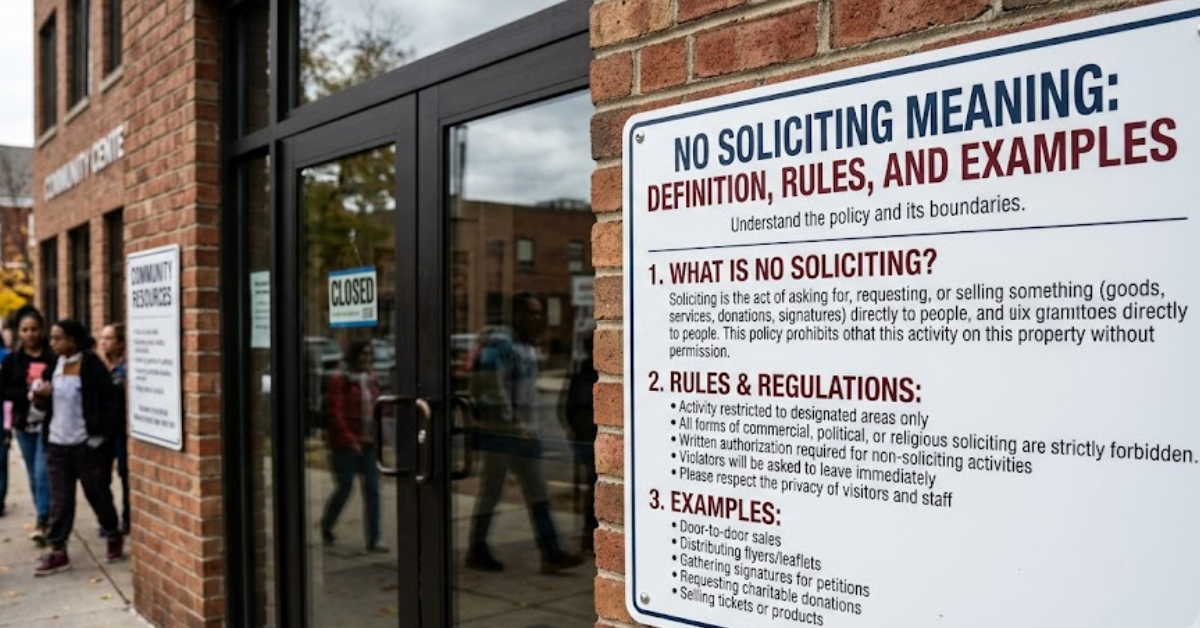
Have you ever walked past a house or business displaying a “No Soliciting” sign and wondered what it actually means? Does it ban everyone from knocking on the door, or only salespeople? The answer is more nuanced than many people realize.
Understanding the no soliciting meaning can help homeowners, businesses, sales professionals, political campaigners, and even neighbors avoid misunderstandings. In this guide, you’ll learn what “no soliciting” means, where these signs are commonly used, who they apply to, what the law says, and how to respect these boundaries in everyday situations.
What Does No Soliciting Mean?
The no soliciting meaning is straightforward: it is a request—or in some cases a legally enforceable notice—that people should not approach a property to sell products, promote services, ask for donations, distribute promotional materials, or seek business.
A “No Soliciting” sign tells visitors that the property owner does not wish to receive unsolicited commercial or promotional visits.
In simple terms, it means:
- Don’t knock on the door to sell something.
- Don’t ask for donations without permission.
- Don’t promote your business or services.
- Don’t distribute advertising materials if prohibited.
The purpose is to protect the occupant’s privacy and reduce unwanted interruptions.
What Is Soliciting?
Before understanding the sign, it’s important to understand the word soliciting itself.
Soliciting generally means requesting something from another person, especially:
- Selling products
- Offering services
- Requesting donations
- Recruiting customers
- Marketing a business
- Asking someone to buy, subscribe, or contribute
The exact legal definition varies depending on local laws, but in everyday language, it usually refers to uninvited sales or promotional activity.
Why Do People Put Up No Soliciting Signs?
Homeowners and businesses install these signs for several reasons.
To Reduce Interruptions
Many people simply don’t want unexpected visitors interrupting work, family time, or personal activities.
To Improve Privacy
A sign establishes personal boundaries and lets visitors know that unsolicited contact isn’t welcome.
To Discourage Aggressive Sales Tactics
Some neighborhoods receive frequent visits from:
- Door-to-door salespeople
- Home improvement companies
- Internet providers
- Solar panel representatives
- Security system marketers
A sign can reduce these visits.
To Increase Security
Homeowners sometimes use these signs to discourage strangers from approaching their property unnecessarily.
What Activities Count as Soliciting?
Soliciting isn’t limited to selling products.
Common examples include:
- Selling magazines
- Offering landscaping services
- Selling pest control
- Marketing roofing services
- Selling solar panels
- Offering internet or cable packages
- Requesting charitable donations
- Asking for religious contributions
- Handing out business advertisements
- Promoting subscription services
These activities generally fall within what most people consider solicitation.
What Does a No Soliciting Sign Usually Apply To?
Although local rules differ, these signs commonly apply to:
Door-to-Door Salespeople
This is the most obvious group.
Examples include:
- Vacuum cleaner sales
- Home security systems
- Window replacement companies
- Roofing contractors
- Internet service providers
Marketing Representatives
Companies often send representatives to introduce products or services in neighborhoods.
Many homeowners display signs specifically to discourage this type of marketing.
Charitable Fundraisers
Organizations requesting donations may also fall under a property’s no-soliciting policy.
However, local regulations sometimes provide exceptions.
Religious Groups
Religious organizations occasionally visit homes to share beliefs or invite residents to events.
Whether they must obey a “No Soliciting” sign depends on local laws and how solicitation is legally defined.
Political Campaign Workers
Political canvassing occupies a unique legal position in many countries.
In some jurisdictions, political speech receives stronger legal protection than commercial solicitation.
As a result, campaign volunteers may have different legal rights than salespeople.
What Does a No Soliciting Sign NOT Mean?
One common misconception is that every visitor is prohibited.
Usually, the sign does not apply to:
- Postal workers
- Delivery drivers
- Emergency responders
- Police officers
- Utility workers
- Invited guests
- Family members
- Friends
- Scheduled service providers
These visitors are generally performing expected or essential duties rather than soliciting.
Is a No Soliciting Sign Legally Enforceable?
The answer depends on where you live.
In many places, the sign serves as notice that visitors are not welcome to conduct solicitation.
Some cities or municipalities have ordinances making it illegal for commercial solicitors to ignore posted signs.
Elsewhere, the sign may not automatically create a legal violation but can strengthen a homeowner’s right to ask someone to leave.
If a solicitor refuses to leave after being asked, trespassing laws may come into play.
Because laws differ, it’s important to understand local regulations.
No Soliciting vs. No Trespassing
These two signs are often confused.
| No Soliciting | No Trespassing |
| Restricts sales or promotional activity | Restricts entering the property without permission |
| Usually targets commercial visitors | Applies to nearly everyone without authorization |
| Allows invited guests | May prohibit all unauthorized entry |
| Focuses on unwanted solicitation | Focuses on unauthorized access |
A property can display both signs at the same time.
No Soliciting vs. No Loitering
These phrases have different meanings.
No Soliciting
- Prohibits sales and promotional activities.
No Loitering
- Prohibits lingering or remaining in an area without a legitimate reason.
Someone standing outside a business for long periods without purpose may violate a no-loitering policy even if they aren’t selling anything.
Common Places You’ll See No Soliciting Signs
These signs appear in many settings, including:
- Residential homes
- Apartment buildings
- Gated communities
- Office buildings
- Medical clinics
- Schools
- Retail businesses
- Warehouses
- Private neighborhoods
Businesses use them to minimize workplace disruptions.
Examples of Soliciting
Here are some everyday examples.
Example 1
A salesperson knocks on your door offering new internet service.
This is solicitation.
Example 2
Someone asks you to purchase a magazine subscription.
This is solicitation.
Example 3
A roofing company offers a free inspection after a storm.
This is usually solicitation.
Example 4
A delivery driver drops off a package.
This is not solicitation.
Example 5
A neighbor comes over to borrow a ladder.
This is not solicitation.
Why Businesses Use No Soliciting Signs
Commercial properties also benefit from limiting unwanted visits.
Advantages include:
- Fewer interruptions
- Better employee productivity
- Increased customer privacy
- Improved workplace security
- Less pressure from sales representatives
Many office buildings display these notices near entrances.
How Sales Professionals Should Respond
Professional sales representatives should always respect posted signs.
Best practices include:
- Read property signs carefully.
- Do not knock if a “No Soliciting” notice is posted.
- Respect homeowner preferences.
- Leave immediately if asked.
- Follow local regulations and company policies.
Respecting boundaries helps maintain professionalism and protects a company’s reputation.
Practical Tips for Homeowners
If you’re considering using a “No Soliciting” sign, these tips can help.
Choose a Visible Location
Place it near:
- Front door
- Gate
- Mailbox
- Entry walkway
Keep the Message Clear
Simple wording often works best:
- No Soliciting
- No Sales Calls
- No Door-to-Door Sales
Stay Polite
If someone ignores the sign, calmly remind them of it rather than escalating the situation.
Common Misconceptions About No Soliciting
“It Stops Everyone From Knocking”
Not necessarily.
Essential workers, invited guests, and deliveries are generally unaffected.
“Ignoring the Sign Is Always Illegal”
Not always.
Whether it violates the law depends on local ordinances and circumstances.
“Religious and Political Visitors Are Always Included”
This varies by jurisdiction because some forms of speech receive greater legal protection than commercial advertising.
Key Takeaways
- The no soliciting meaning is a request to stop unwanted sales and promotional visits.
- Soliciting usually includes selling products, offering services, or requesting donations.
- These signs help protect privacy and reduce interruptions.
- Laws differ depending on local government regulations.
- A “No Soliciting” sign is different from a “No Trespassing” sign.
- Delivery personnel and invited guests are generally not considered solicitors.
- Respecting posted signs promotes good relationships between visitors and property owners.
Frequently Asked Questions
What is the simple meaning of no soliciting?
The no soliciting meaning is that people should not visit the property to sell products, advertise services, or request donations without permission.
Does no soliciting include religious groups?
Sometimes. The answer depends on local laws because religious outreach may be treated differently from commercial sales activity.
Can political campaign workers ignore a no soliciting sign?
Political canvassing may have different legal protections than commercial solicitation in some jurisdictions. Whether campaign workers must comply depends on local regulations.
Is handing out flyers considered soliciting?
Often, yes. Distributing advertisements or promotional materials can fall under solicitation, especially when done for commercial purposes.
What’s the difference between no soliciting and no trespassing?
A No Soliciting sign focuses on preventing sales and promotional activities, while a No Trespassing sign restricts unauthorized entry onto private property.
Can businesses post no soliciting signs?
Yes. Many offices, stores, and commercial buildings use these signs to reduce interruptions and maintain a productive environment.
Conclusion
The no soliciting meaning goes beyond simply asking salespeople to stay away. It represents a property owner’s desire for privacy, fewer interruptions, and greater control over who approaches their home or business. While the exact legal effect varies by location, these signs generally discourage unsolicited commercial activity and encourage respectful interactions.
Whether you’re a homeowner looking to protect your space, a business aiming to reduce disruptions, or a salesperson trying to follow best practices, understanding what “No Soliciting” means helps avoid confusion and promotes respectful communication. Knowing the distinction between solicitation, trespassing, and other forms of contact allows everyone to navigate these situations with greater confidence.
Leave a Reply