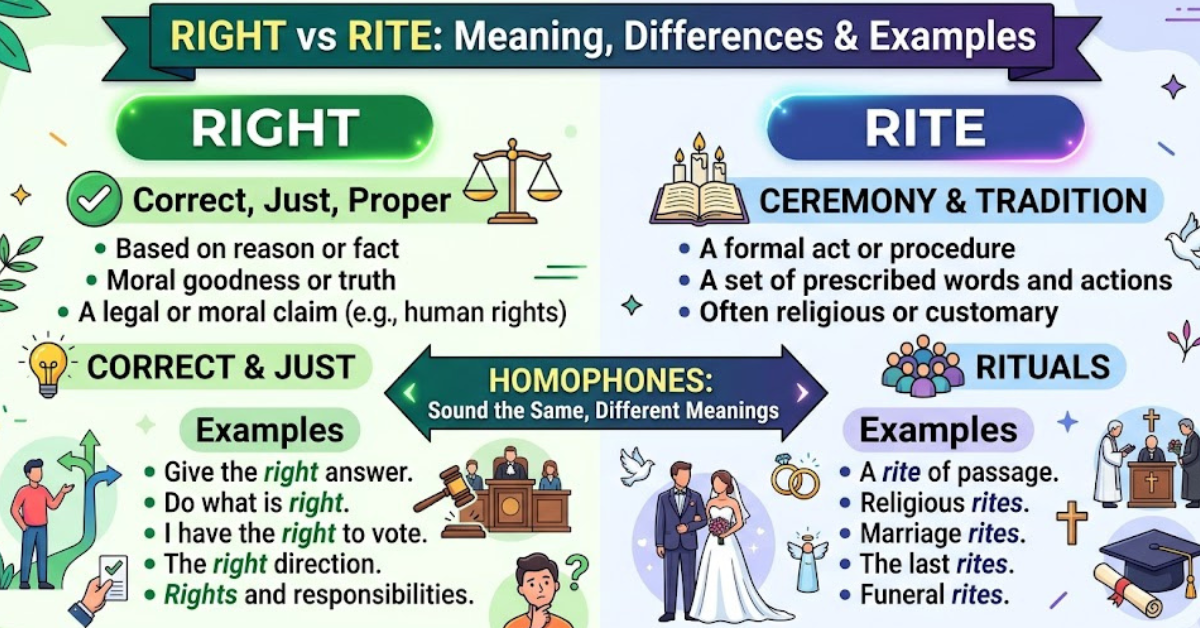
The confusion between Right vs Rite is more common than you might think, especially in English writing and speech. These two words sound exactly the same, but their meanings are completely different. One relates to correctness or direction, while the other is tied to rituals and ceremonies.
Understanding Right vs Rite is essential for clear communication, especially in writing where spelling mistakes can change the entire meaning of a sentence. In this guide, we’ll break down both words, explore their usage, and give simple examples so you never mix them up again.
What Does “Right” Mean?
The word “right” is one of the most versatile words in the English language. It can function as an adjective, adverb, noun, or even a verb depending on the context.
Common meanings of “Right”
Here are the main uses of right:
- Correct or true
- Example: You got the answer right.
- Direction (opposite of left)
- Example: Turn right at the traffic light.
- Moral or legal entitlement
- Example: Everyone has the right to freedom of speech.
- Proper or appropriate
- Example: It’s not right to lie.
Everyday usage of “Right”
In daily communication, “right” appears in many contexts:
- Checking correctness: “Am I right?”
- Giving directions: “Go right after the bridge.”
- Agreeing: “That’s right!”
So, when you see right, think of correctness, direction, or justice.
What Does “Rite” Mean?
Unlike “right,” the word “rite” is much more specific and less commonly used in everyday conversation.
Definition of “Rite”
A rite refers to a formal or ceremonial act, often connected to religion, culture, or tradition.
Common examples of “rite”
- Religious ceremony
- Example: A wedding rite in a church or temple.
- Cultural rituals
- Example: Coming-of-age rites in different societies.
- Traditional practices
- Example: Burial rites performed after death.
Key idea behind “Rite”
Think of rite as something structured, symbolic, and ceremonial. It usually follows a set tradition or ritual pattern.
Right vs Rite: Key Differences Explained
Understanding Right vs Rite becomes easy when you compare them side by side.
1. Meaning
- Right → correctness, direction, moral fairness
- Rite → ceremony, ritual, tradition
2. Usage context
- Right is used in everyday language, law, ethics, and directions
- Rite is used in religious, cultural, or ceremonial contexts
3. Frequency
- Right is extremely common
- Rite is relatively rare
4. Example comparison
- You have the right to speak freely.
- A wedding rite is performed during the ceremony.
Easy Memory Trick for Right vs Rite
If you often confuse the two, this simple trick will help:
- Right = “Correct or Direction” (think normal daily life)
- Rite = “Ritual” (both start with R, so they match)
Another way to remember:
- If it’s about rules, correctness, or direction → Right
- If it’s about rituals or ceremonies → Rite
Common Mistakes People Make
Many learners mix up Right vs Rite in writing. Here are typical errors:
- “Marriage right” (incorrect if referring to ceremony)
“Marriage rite” - “It is a sacred right” (wrong if meaning ritual)
“It is a sacred rite” - “Turn rite at the corner”
“Turn right at the corner”
Being mindful of context solves most of these mistakes.
Why Understanding Right vs Rite Matters
Clear writing is not just about grammar—it’s about meaning. Mixing up Right vs Rite can:
- Change the meaning of a sentence entirely
- Confuse readers
- Make writing look unprofessional
Whether you’re writing essays, emails, or content online, using the correct word improves clarity and credibility.
Real-Life Examples of Right vs Rite
Right in sentences:
- You are right about the solution.
- Everyone deserves equal rights.
- Please take a right turn after the signal.
Rite in sentences:
- The wedding rite was performed at sunset.
- Ancient burial rites vary across cultures.
- The initiation rite is an important tradition.
FAQs on Right vs Rite
1. What is the main difference between Right vs Rite?
Right refers to correctness, direction, or entitlement, while rite refers to a ritual or ceremony.
2. Is “rite” commonly used in English?
Not really. It is mostly used in formal, religious, or cultural contexts.
3. Can “right” and “rite” ever mean the same thing?
No. They are homophones (sound the same) but have completely different meanings.
4. How do I remember Right vs Rite easily?
Associate rite with “ritual,” and right with “correct or direction.”
5. Why do people confuse Right vs Rite?
Because they are pronounced the same but spelled differently, which leads to spelling errors in writing.
Conclusion
The confusion between Right vs Rite is understandable, but once you break it down, the difference becomes clear. Right deals with correctness, direction, and fairness, while rite is all about rituals and ceremonies.
By remembering their meanings and practicing with examples, you can avoid common mistakes and write with confidence. If you’re interested in improving your grammar further, exploring other commonly confused word pairs can be a great next step.
Leave a Reply