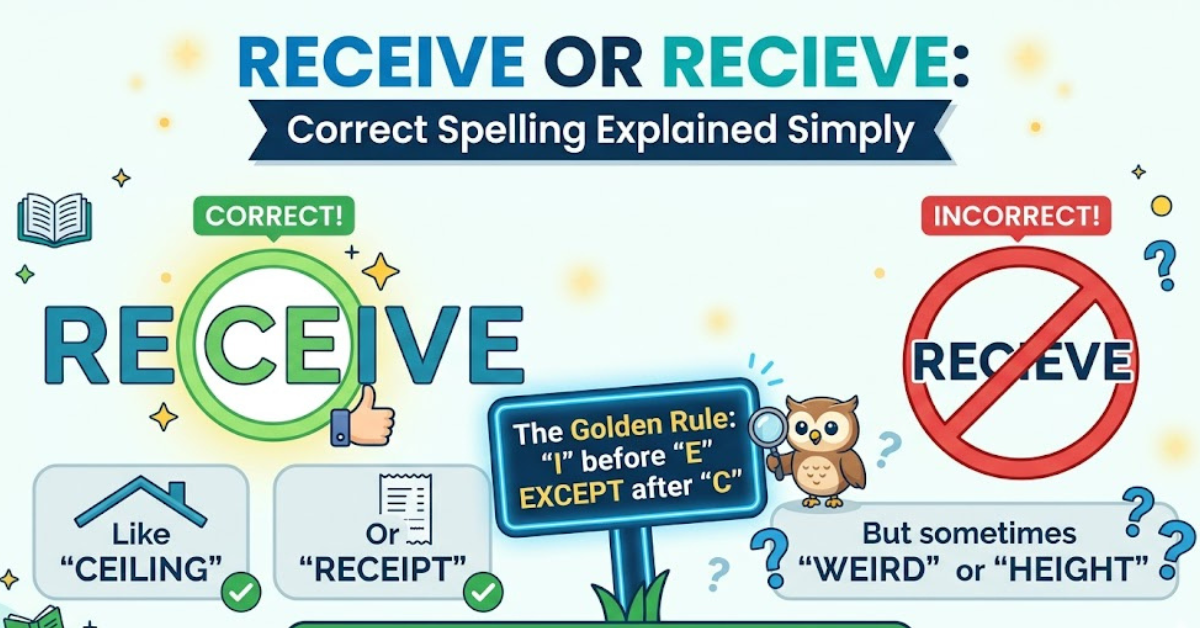
Ever paused mid-sentence wondering whether it’s receive or recieve? You’re not alone. This is one of the most common spelling mistakes in English, even among fluent writers. The correct form is receive, and the incorrect spelling “recieve” often trips people up because of pronunciation confusion.
In this guide, we’ll break down the correct usage of receive or recieve, explain why the mistake happens, and give you simple memory tricks so you never get it wrong again.
What Is the Correct Spelling: Receive or Recieve?
The correct spelling is receive.
The word follows a well-known English spelling rule:
“I before E, except after C”
Since “receive” contains the letter C before the “ei/ie” combination, it becomes ei, not ie.
Correct:
- receive
- receiver
- receiving
Incorrect:
- recieve
- reciever
- recieving
Meaning of “Receive” (Definition & Usage)
The word receive means to get, accept, or be given something.
It is commonly used in different contexts such as communication, finance, and everyday actions.
Examples of “receive” in sentences:
- I will receive the parcel tomorrow.
- She didn’t receive the email on time.
- They received a warm welcome at the airport.
Why Do People Confuse “Receive or Recieve”?
The confusion between receive or recieve happens mainly due to pronunciation and spelling patterns.
Common reasons include:
- The “ee” sound makes people think it should be “ie”
- Overgeneralizing English spelling rules incorrectly
- Typing errors and autocorrect mistakes
- Lack of visual memory of the correct form
Even native English speakers make this mistake occasionally.
Easy Tricks to Remember the Correct Spelling
If you struggle with receive or recieve, these memory tricks can help:
1. The “C Rule” Trick
Remember:
C comes before EI → receive
2. Break It Down
Split it like this:
- re + ceive = receive
3. Think of Related Words
Words like:
- deceive
- conceive
- perceive
All follow the same pattern: -ceive
Common Words Related to “Receive”
Understanding related terms helps reinforce correct spelling and usage:
- Receipt – proof of receiving something
- Reception – act of receiving guests or signals
- Receiver – person who receives something
- Receiving – ongoing action of getting something
These words follow similar spelling logic and often help learners remember “receive.”
Receive in Different Contexts
The word receive is used across various fields:
1. Daily Life
- Receive gifts, letters, or packages
2. Business
- Receive payments, invoices, or orders
3. Technology
- Receive messages, emails, or signals
4. Sports
- Receive a pass or serve
FAQs About Receive or Recieve
1. Which is correct: receive or recieve?
The correct spelling is receive. “Recieve” is incorrect.
2. Why do people write “recieve” instead of “receive”?
It usually happens due to confusion with pronunciation and English spelling rules.
3. What is the rule for “receive”?
It follows the rule: “I before E except after C.”
4. Is “recieve” ever acceptable in English?
No, “recieve” is always considered a spelling mistake.
5. How can I remember the correct spelling?
Remember that words with “ceive” (like receive, perceive, deceive) all follow the same pattern.
Conclusion
The confusion between receive or recieve is common, but the rule is simple: the correct spelling is receive. Once you remember the “C before EI” pattern and recognize related words like perceive and deceive, you’ll avoid the mistake easily.
Mastering small spelling differences like this improves your writing clarity and professionalism. Keep practicing, and soon “receive” will feel natural every time you write it.
Leave a Reply