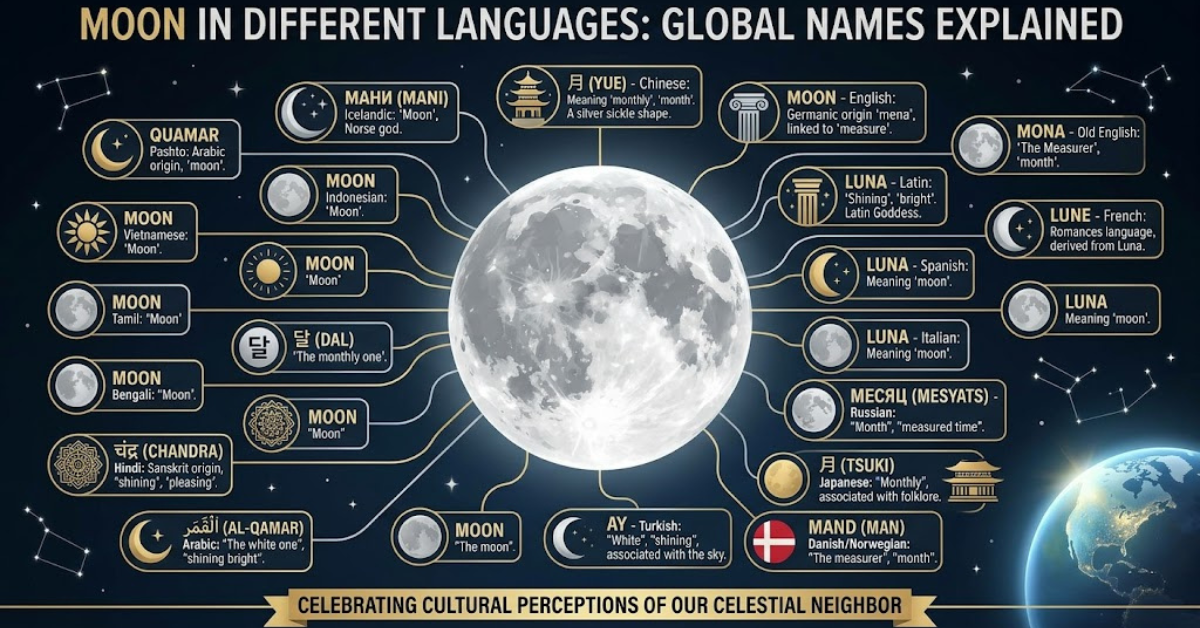
The moon in different languages is more than just a translation exercise—it’s a glimpse into how cultures see the night sky, mythology, and time itself. From “Luna” in Latin-based languages to “Chand” in South Asia, the moon carries unique names and meanings across the world.
In this guide, we’ll explore how the moon in different languages is expressed globally, along with its linguistic roots, cultural significance, and fascinating variations.
What Does “Moon in Different Languages” Mean?
When we talk about the moon in different languages, we’re referring to the way various cultures name Earth’s natural satellite. These names often come from:
- Ancient mythology and gods
- Scientific Latin roots
- Descriptive words based on appearance
- Cultural and poetic traditions
Interestingly, while the object remains the same, its name changes dramatically depending on language and history.
Moon in Different Languages Around the World
Here’s how the moon in different languages appears across major global languages:
European Languages
- English: Moon
- Spanish: Luna
- French: Lune
- German: Mond
- Italian: Luna
- Portuguese: Lua
- Russian: Луна (Luna)
In many European languages, “Luna” comes from ancient Roman mythology, where Luna was the goddess of the moon.
Asian Languages
- Hindi: चाँद (Chand)
- Urdu: چاند (Chand)
- Chinese (Mandarin): 月亮 (Yuèliàng)
- Japanese: 月 (Tsuki)
- Korean: 달 (Dal)
- Thai: พระจันทร์ (Phra Jan)
Asian languages often connect the moon with beauty, poetry, and time cycles like calendars and festivals.
Middle Eastern Languages
- Arabic: القمر (Al-Qamar)
- Persian (Farsi): ماه (Māh)
- Turkish: Ay
In Arabic, “Al-Qamar” is also mentioned in the Quran, showing its deep cultural and spiritual importance.
African Languages (Examples)
- Swahili: Mwezi
- Amharic: ጨረቃ (Cherika)
In many African cultures, the moon is tied to farming cycles and traditional calendars.
Why Do Moon Names Differ Across Languages?
The variation in the moon in different languages comes from:
1. Cultural Influence
Different civilizations created their own myths and names for celestial objects.
2. Latin and Greek Roots
European languages often borrowed from Latin “Luna” and Greek mythology.
3. Phonetic Evolution
Words changed over centuries based on pronunciation habits.
4. Symbolic Meaning
The moon often represents femininity, time, and mystery—shaping how it is named.
Interesting Linguistic Facts About the Moon
- Many languages use two words: one scientific and one poetic.
- “Luna” is the root of words like lunar, lunatic, and lunar calendar.
- In East Asia, the same character 月 can mean both “moon” and “month.”
- Some languages link the moon directly to night or light rather than naming it separately.
FAQs About Moon in Different Languag’s
1. What is the most common word for moons worldwide?
“Luna” and its variations (lune, lua, luna) are among the most widespread.
2. What is moon called in Urdu and Hindi?
It is called “Chand” (چاند / चाँद).
3. What is the scientific name of the moon?
The scientific term is simply Earth’s natural satellite, but “Luna” is used in astronomy.
4. Why does the moons have different names in languages?
Because languages developed independently, shaped by culture, history, and mythology.
5. What is moon called in Japanese and Chinese?
- Japanese: Tsuki (月)
- Chinese: Yuèliàng (月亮)
Conclusion
Exploring the moon in different languages shows how deeply language is tied to culture and imagination. While the moon itself remains constant in the sky, its name changes beautifully across regions—from Luna in Europe to Chand in South Asia and Tsuki in Japan.
Understanding these differences not only improves linguistic knowledge but also connects us to the shared human fascination with the night sky. If you enjoyed this journey, explore more global language guides to discover how everyday words change around the world.
Leave a Reply