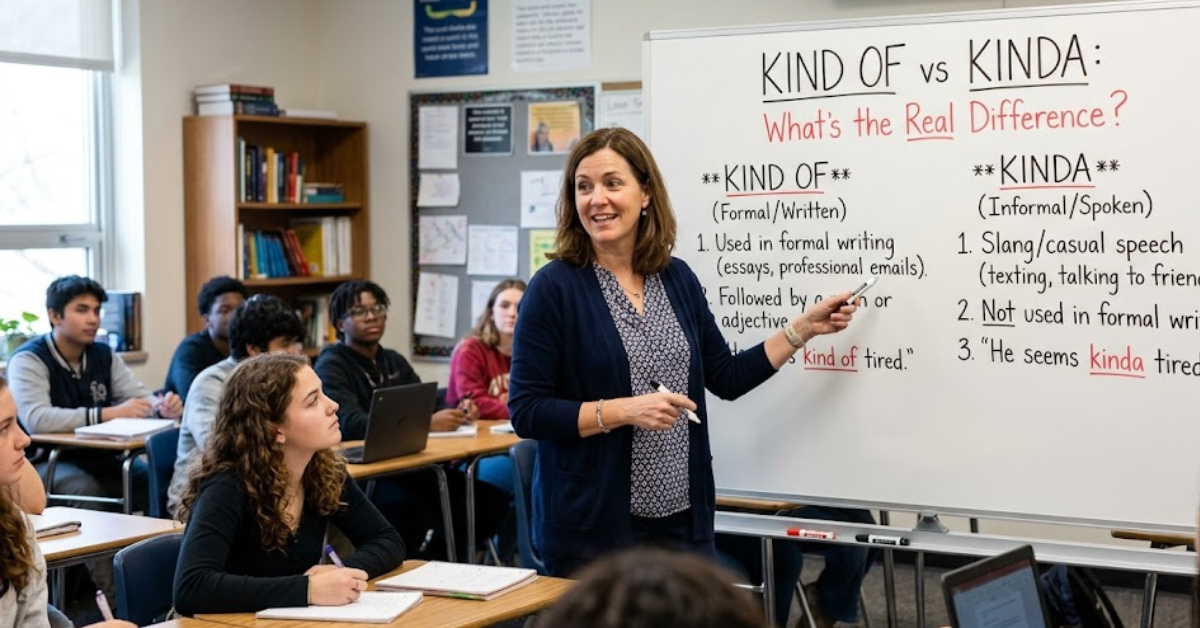
Few English expressions confuse writers quite like “kind of” and “kinda.” They sound almost identical in conversation, yet they create very different impressions in writing. One appears in professional emails, essays, and articles, while the other is mostly reserved for casual speech and informal texting.
Understanding the difference between Kind Of vs Kinda can instantly improve your writing style, tone, and grammar accuracy. Whether you are writing a blog post, sending a message, or speaking casually with friends, knowing when to use each expression matters more than many people realize.
In this guide, you will learn the meaning of both phrases, their grammatical differences, when they are appropriate, and common mistakes people make when using them.
What Does “Kind Of” Mean?
“Kind of” is a standard English phrase used to express:
- Partial agreement
- Uncertainty
- Approximation
- Mild description
It often softens a statement so it sounds less direct or less absolute.
Examples:
- I’m kind of tired today.
- That movie was kind of interesting.
- She looked kind of upset.
In these examples, the phrase adds a sense of moderation. The speaker is not making a strong or definite statement.
The expression can also refer to a category or type.
Examples:
- What kind of music do you like?
- This kind of problem happens often.
In this usage, “kind of” means “type of.”
What Does “Kinda” Mean?
“Kinda” is simply an informal pronunciation and spelling variation of “kind of.”
People commonly use it in:
- Text messages
- Social media posts
- Casual dialogue
- Informal speech
Examples:
- I’m kinda hungry.
- That sounds kinda weird.
- She’s kinda busy right now.
Although it is widely used in everyday conversation, “kinda” is considered nonstandard in formal writing.
Kind Of vs Kinda: The Main Difference
The biggest difference comes down to formality and writing style.
“Kind of” is grammatically standard and accepted in all forms of writing. “Kinda” is conversational and informal.
Here is the simplest way to think about it:
- Use “kind of” in professional, academic, or polished writing.
- Use “kinda” in relaxed, casual communication.
Even though they usually carry the same meaning, the tone changes significantly.
Example Comparison
Formal:
- The presentation was kind of confusing.
Casual:
- The presentation was kinda confusing.
Both sentences communicate the same idea, but the second sounds much more conversational.
Is “Kinda” a Real Word?
Yes, dictionaries now recognize “kinda” as an informal word because of its widespread use in spoken English.
However, recognition does not mean it fits every context.
English contains many accepted informal words that are still inappropriate in professional settings. “Kinda” falls into that category.
For example, you would not usually write:
- A job application
- A research paper
- A business proposal
- An academic assignment
using “kinda.”
Instead, you would choose the standard phrase.
When to Use “Kind Of”
Use “kind of” when clarity, professionalism, or correctness matters.
Best Situations for Using “Kind Of”
- Academic writing
- Business communication
- Professional emails
- Articles and reports
- Formal presentations
Examples:
- The results were kind of unexpected.
- I’m kind of concerned about the timeline.
- This solution is kind of effective but needs improvement.
In formal writing, the phrase sounds natural without appearing too casual.
When to Use “Kinda”
“Kinda” works best when the tone is relaxed and conversational.
Common Places People Use “Kinda”
- Texting friends
- Online chats
- Dialogue in fiction
- Social media captions
- Casual storytelling
Examples:
- I’m kinda excited about the weekend.
- That was kinda awkward.
- He’s kinda funny once you know him.
Writers sometimes use it intentionally to make dialogue sound realistic and human.
Why People Prefer “Kinda” in Conversation
Spoken English naturally becomes shorter and smoother over time. Native speakers often combine words to make speech faster and easier.
That is why expressions like these exist:
- Going to → gonna
- Want to → wanna
- Got to → gotta
- Kind of → kinda
In everyday speech, people rarely pronounce every word perfectly. Informal contractions and blended sounds make conversation feel more natural.
Common Grammar Mistakes
Many learners confuse informal speech with proper writing standards.
Here are some mistakes to avoid.
Using “Kinda” in Formal Writing
Incorrect:
- The experiment was kinda successful.
Better:
- The experiment was kind of successful.
Overusing Either Phrase
Using these expressions too frequently can weaken writing.
Weak:
- The article was kind of boring and kind of repetitive.
Stronger:
- The article was repetitive and slightly boring.
Too much softening makes sentences less confident and less clear.
Is “Kind Of” Always Better?
Not necessarily.
The better choice depends entirely on tone and audience.
If you are writing a relaxed blog post, dialogue, or friendly message, “kinda” may actually sound more authentic.
For example:
- I’m kinda nervous about the interview.
This sounds natural and conversational.
Replacing it with “kind of” creates a slightly more polished tone:
- I’m kind of nervous about the interview.
Neither is wrong. The context determines which one fits better.
The Tone Difference Matters
Word choice shapes how readers perceive you.
Using “kind of” often sounds:
- More polished
- More careful
- More professional
Using “kinda” sounds:
- More casual
- More relaxed
- More conversational
That subtle distinction can change the overall voice of your writing.
Similar Informal Expressions
If you understand this comparison, you will also recognize similar patterns in English.
Examples include:
- Sort of → sorta
- Let me → lemme
- Give me → gimme
These forms are common in speech but usually avoided in formal writing.
How Native Speakers Use Them
Native speakers switch between these forms constantly depending on context.
Someone might write:
- I’m kind of interested in the opportunity.
in a work email but text a friend:
- I’m kinda tired today.
The ability to shift tone naturally is an important communication skill.
Should English Learners Use “Kinda”?
Yes, but carefully.
Understanding informal English helps learners sound more natural in conversation. However, it is important to know when informal expressions are inappropriate.
A good rule is:
- Learn informal forms for listening and speaking.
- Use standard forms for professional writing.
That balance helps you communicate confidently in every situation.
FAQs
Is “kinda” grammatically correct?
“Kinda” is considered informal but widely accepted in casual English. It is not usually appropriate for formal writing.
Can I use “kinda” in professional emails?
It is better to avoid it. Use “kind of” instead for a more polished and professional tone.
Are “kind of” and “kinda” interchangeable?
In most casual situations, yes. However, they create different levels of formality.
Why do people say “kinda” instead of “kind of”?
People naturally shorten words and phrases in spoken English to make conversation smoother and faster.
Is “kinda” slang?
Not exactly. It is more accurately described as an informal contraction or spoken variation.
Which sounds more natural in conversation?
“Kinda” often sounds more natural in relaxed speech, while “kind of” sounds slightly more formal and deliberate.
Conclusion
The debate around Kind Of vs Kinda is really about tone, context, and audience. Both expressions communicate similar meanings, but they belong in different situations.
“Kind of” remains the safer and more professional option for formal writing, academic work, and business communication. “Kinda,” on the other hand, adds a casual and conversational feel that works well in everyday speech and informal writing.
Understanding when to use each one can make your communication sound more natural, polished, and appropriate for the situation. Small language choices like these may seem minor, but they have a major impact on how your writing is perceived.
If you want to improve your English even further, continue exploring commonly confused words, informal expressions, and grammar usage patterns that shape modern communication.
Leave a Reply