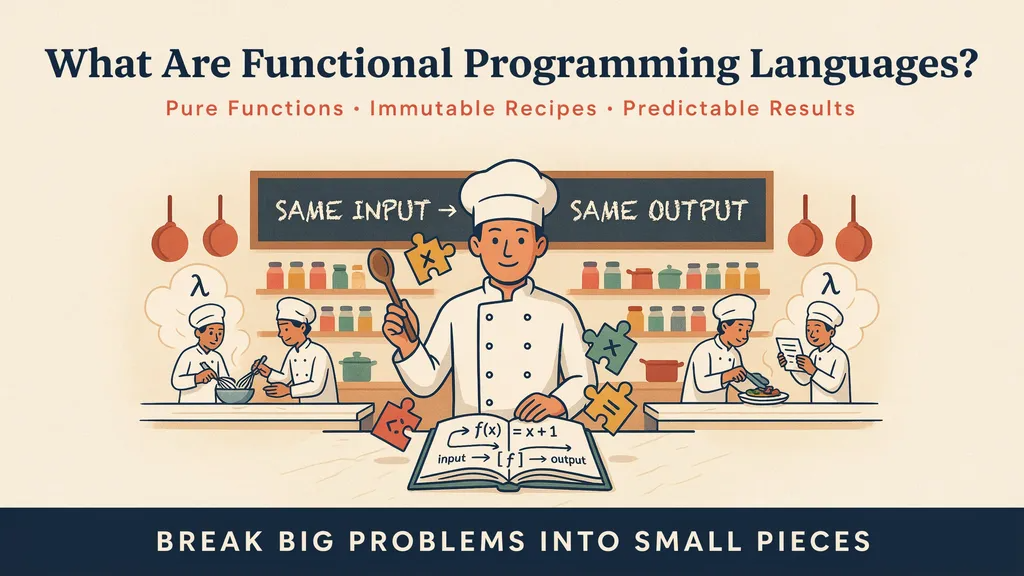
Have you ever wondered how computers do so many cool things at once without getting confused? Think of them like a giant kitchen where chefs work together. Functional Programming Languages are a special type of computer code. They help us write instructions using pure math functions. Instead of telling the computer step-by-step how to change data, we give it rules. These rules are like recipes that never change. When you give the recipe the same ingredients, you always get the exact same delicious meal. This makes your code super safe and easy to test. Many popular coding styles use this trick today to build fast apps and websites. You do not need a degree in math to understand the basic idea. It is all about breaking big problems into small, neat puzzle pieces. Let us dive in and see why so many developers love using these neat tools every single day.
Why Pure Functions Change Everything
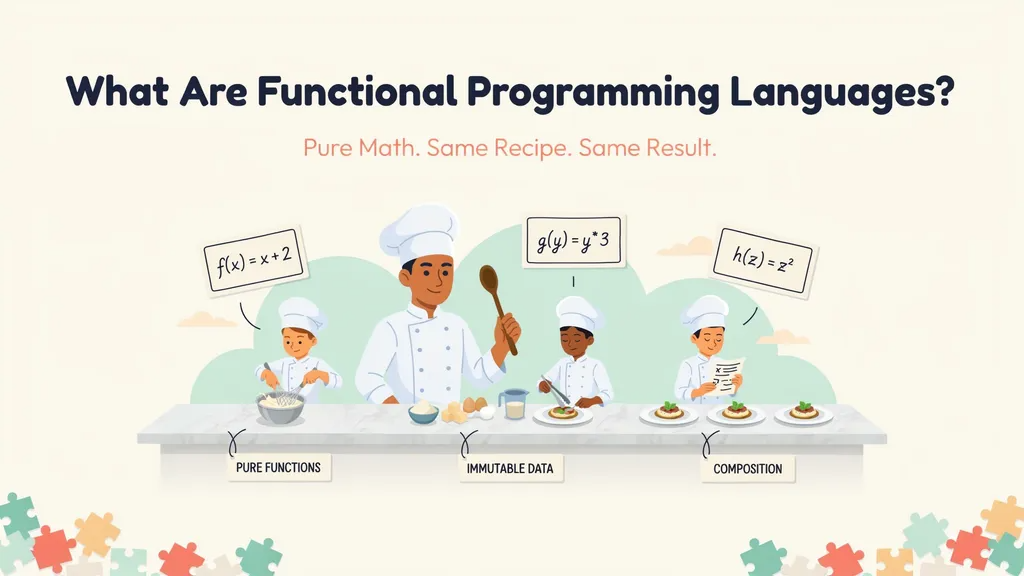
Inside functional programming languages, we rely heavily on something called pure functions. Imagine a light switch that always turns on the light when you flip it up. That is a pure function. It takes an input, does a simple job, and gives you an output without changing anything else in the room. In regular coding, things often change behind your back, which leads to annoying bugs. But with pure functions, you never have to worry about surprise errors. When I first started writing code this way, it felt like magic. My programs stopped crashing randomly, and testing became a breeze. You always know what to expect because the rules are strict. This predictability saves hours of staring at a computer screen trying to spot silly mistakes. It is one of the best secrets to writing clean and healthy code.
Immutability: Keeping Your Data Safe
Have you ever shared a document with a friend, and they accidentally deleted your favorite sentence? That can happen in traditional computer code when data changes unexpectedly. Functional programming languages solve this with a cool rule called immutability. Once you create a piece of data, it stays frozen just like a carved stone statue. You cannot edit it directly. If you want to change something, you make a brand-new copy instead. This simple habit keeps your original data completely safe from accidental mix-ups. Think of it like taking a photo copy of a drawing before you paint on it. Your original drawing remains perfect and untouched. Working this way makes building large software projects much less stressful. You can trust that your variables will not change when you look away.
The Magic of Higher-Order Functions
Functions in functional programming languages are treated like VIP guests at a party. You can pass them around, store them in variables, or even send them inside other functions as gifts. We call these special helpers higher-order functions. Imagine having a magic tool that can transform any toy you give it into a spaceship. That is basically what these functions do for your code. They let you write smart, reusable blocks of instructions that save you from repeating yourself. Instead of writing the same loop over and over, you write one smart function and hand it different jobs. This keeps your project files small and tidy. It also makes your code read more like a storybook than a boring math test.
Recursion Instead of Loops
When we want to repeat a task in functional programming languages, we rarely use standard loops like for or while. Instead, we use a neat trick called recursion. Recursion is when a function calls itself to solve a smaller piece of a giant puzzle. Think of it like opening a set of Russian nesting dolls. You open one doll to find a smaller doll inside, and you keep going until you reach the tiny final piece. Writing code this way feels very artistic and clean once you get the hang of it. It helps you break down tricky problems like searching through giant folders or sorting lists. While it might take a little practice to wrap your head around, it becomes second nature very quickly.
Popular Functional Programming Languages to Learn
If you are excited to try out this amazing style of coding, you might wonder where to start. There are several fantastic functional programming languages used by top tech companies today. Haskell is a pure language that forces you to use these rules strictly, making it great for learning strong habits. Scala and Clojure mix these ideas with other coding styles, giving you the best of both worlds. Even popular languages like JavaScript, Python, and Java have borrowed these awesome tricks over the years. When I was picking my first language to practice these concepts, I started with JavaScript because it was super easy to test in my web browser. You do not have to switch everything you do overnight. Just pick one language and try writing a single pure function today.
Real-World Uses for Functional Code
You might be wondering where people actually use functional programming languages in the real world. The truth is, they run behind the scenes of many apps you use every single day. Streaming services use them to recommend your favorite shows without crashing when millions of people log on at once. Financial banks rely on them to handle super secure money transfers safely. Because these languages handle many tasks at the same time without messing up data, they are perfect for massive cloud systems. Whenever you see a website load instantly or a game run smoothly, functional design is often helping out behind the curtains. It is a powerful way to build software that millions of people can trust.
Writing Clean Code That Anyone Can Read
One of the best perks of functional programming languages is how neat your project files look. Because you break everything down into small, bite-sized functions, your code reads like a simple instruction manual. If a friend or coworker looks at your work tomorrow, they can easily figure out what is happening. Clear variable names and short functions mean fewer headaches for everyone involved. I always tell beginners to write their code as if a friendly robot is going to read it back to them out loud. If it sounds confusing or messy, it is time to simplify. Clean code is happy code, and happy code leads to fewer bugs and more free time for you.
Comparing Functional and Traditional Code
| Feature | Traditional Coding | Functional Programming Languages |
| Data Style | Data can change anytime (Mutable) | Data stays frozen and safe (Immutable) |
| Repetition | Uses standard loops | Uses smart recursion and mapping |
| Main Focus | Step-by-step instructions | Mathematical rules and pure functions |
| Debugging | Can be tricky when variables shift | Much easier because values never move |
Common Myths About Functional Programming
Some people think functional programming languages are only for super smart math professors in giant universities. That is just a silly myth! While the concepts come from math, the actual day-to-day use is very practical and fun. Another common worry is that your computer will run slower using these rules. Modern computers and compilers are actually super smart at speeding up pure code automatically. You do not need to memorize complex formulas to get started. All you need is curiosity and a willingness to try a fresh way of thinking. Once you let go of old habits, you will see that these tools are designed to make your life much easier, not harder.
Frequently Asked Questions
What are functional programming languages in simple terms?
They are computer languages that use pure math rules and unchanging data to solve problems safely and clearly.
Are these languages hard for beginners to learn?
Not at all! While they think a bit differently than traditional code, starting with small functions makes learning very smooth.
Why do developers love using immutability?
Immutability stops data from changing by surprise, which prevents annoying bugs and keeps your app stable.
Can I use these concepts in regular JavaScript or Python?
Yes, modern languages like JavaScript and Python let you use pure functions and higher-order tricks easily.
What is a pure function?
A pure function is a block of code that always gives the exact same output when given the exact same input.
Do I need to be good at math to use them?
You only need basic logic skills. You do not need advanced calculus or algebra to write great code.
Conclusion
Mastering functional programming languages is an incredible journey that will totally change how you look at writing code. By keeping your data safe, using pure functions, and breaking big problems into tiny steps, you can build amazing things with confidence. Every expert coder started out as a complete beginner, so take it one small step at a time. Grab your favorite notebook, fire up your computer, and try writing your very first pure function today. If you enjoyed reading this guide, share it with a friend who loves coding, or leave a comment below with your favorite programming language!
Leave a Reply