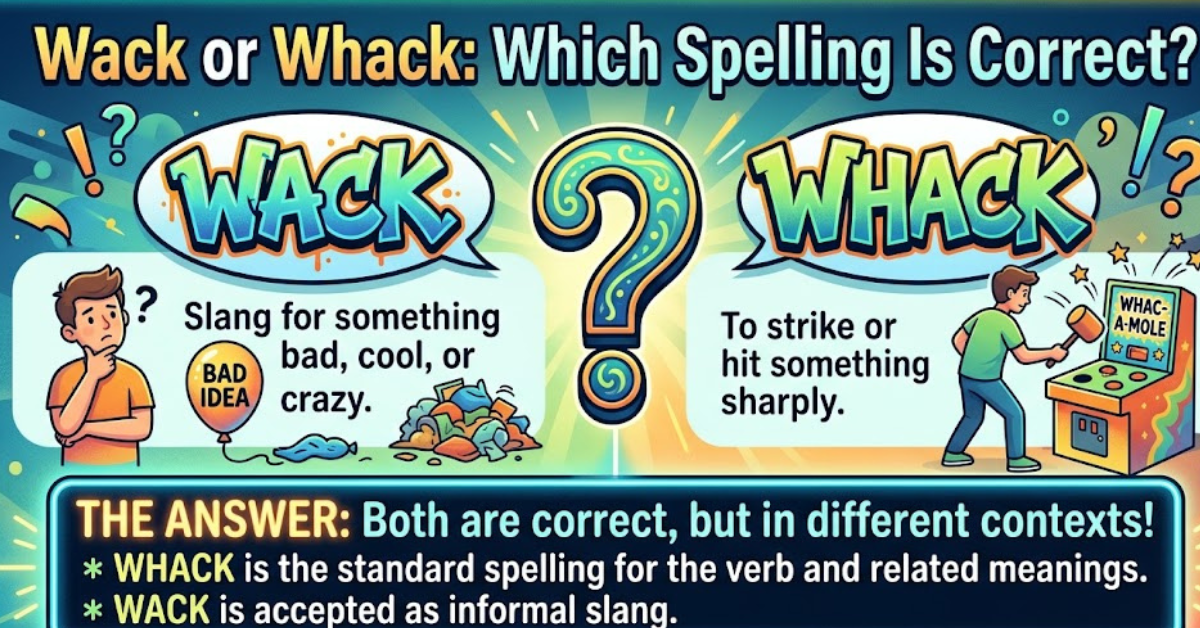
Have you ever seen someone write “that movie was wack” and wondered whether it should actually be “whack”? You’re not alone. The debate around wack or whack is surprisingly common, especially in online conversations, social media posts, song lyrics, and everyday slang.
English is full of words that evolve over time, and this is one of those fascinating cases where spelling, culture, and language trends intersect. In this guide, you’ll learn the difference between the two spellings, where they came from, when each is appropriate, and how to avoid common mistakes.
Understanding the Difference Between Wack and Whack
At first glance, these words look almost identical. However, their meanings and usage are not always the same.
What Does “Whack” Mean?
Traditionally, whack is the standard dictionary spelling.
As a verb, it means:
- To hit something forcefully
- To strike with a blow
- To attack or knock
Examples:
- He whacked the baseball over the fence.
- She whacked the mosquito with a newspaper.
- The carpenter whacked the nail with a hammer.
As a noun, it can refer to a hit or strike.
Example:
- The ball landed with a loud whack.
In informal English, whack can also mean strange, odd, or ridiculous.
Example:
- That excuse sounds whack.
What Does “Wack” Mean?
Wack emerged primarily as slang and became popular through urban culture, hip-hop communities, and youth language.
It usually means:
- Bad
- Uncool
- Low quality
- Disappointing
- Boring
Examples:
- That song is wack.
- The movie was totally wack.
- His attitude is wack.
Although some dictionaries now recognize wack as an informal slang term, it originated as a nonstandard variation of whack.
The Origins of Wack and Whack
The History of “Whack”
The word whack has existed in English for centuries. It was originally associated with striking or hitting something with force.
Over time, the word expanded beyond physical action and began appearing in expressions describing unusual or eccentric behavior.
Examples include:
- Out of whack
- Whack job
- Whacked out
These expressions remain common today.
The Rise of “Wack” in Popular Culture
The spelling wack gained significant popularity during the 1980s and 1990s.
Hip-hop artists, DJs, and street culture frequently used the term to describe something that lacked quality or authenticity.
In rap battles and music reviews, calling something “wack” became a powerful insult.
For example:
- A weak performance was considered wack.
- Poor lyrics were labeled wack.
- Fake behavior was often called wack.
As hip-hop culture spread globally, the spelling became widely recognized.
Which Spelling Is Correct?
In Formal Writing
If you’re writing:
- Academic papers
- Business communications
- Professional content
- News articles
Whack is generally the safer and more accepted spelling.
Most style guides and dictionaries recognize it as the standard form.
In Informal Slang
When describing something as bad or uncool, wack is commonly accepted in casual conversation.
Examples:
That game is wack.
His excuse was wack.
These examples reflect modern slang usage rather than traditional grammar.
Wack vs Whack: Side-by-Side Comparison
| Feature | Wack | Whack |
| Standard dictionary word | Limited recognition | Yes |
| Means “to hit” | No | Yes |
| Means “bad or uncool” | Yes | Sometimes |
| Common in slang | Very common | Common |
| Formal writing | Usually avoided | Preferred |
| Popular in hip-hop culture | Strongly associated | Less associated |
Why Do People Get Confused?
Several factors contribute to confusion.
Similar Pronunciation
Both words are typically pronounced the same way:
/wæk/
Because they sound identical, many people assume they’re interchangeable.
Slang Evolution
Language constantly changes.
Words that begin as slang often gain widespread acceptance over time. As a result, many younger speakers encounter “wack” first through music, social media, or online discussions.
Internet Influence
Online platforms accelerate language changes.
Social media, memes, and digital communication have helped normalize alternative spellings that may not have been accepted in traditional writing decades ago.
Common Expressions Using Whack
Many popular English expressions use the traditional spelling.
Out of Whack
Meaning:
- Not functioning properly
- Not balanced
- Not normal
Example:
- My sleep schedule is completely out of whack.
Whack Job
Meaning:
- An eccentric or strange person
Example:
- People thought the inventor was a whack job at first.
Whacked Out
Meaning:
- Exhausted
- Confused
- Acting strangely
Example:
- After working all night, I felt completely whacked out.
When to Use Wack
Use wack when:
- Writing dialogue
- Posting on social media
- Mimicking spoken slang
- Discussing hip-hop culture
- Quoting someone directly
Examples:
- That beat is wack.
- The ending was wack.
- The service was wack today.
This spelling often conveys a specific cultural tone that “whack” may not fully capture.
When to Use Whack
Use whack when:
- Referring to hitting something
- Writing formally
- Following standard dictionary conventions
- Using established English expressions
Examples:
- He whacked the ball.
- The machine is out of whack.
- She gave the table a quick whack.
How Dictionaries Treat the Two Words
Modern dictionaries increasingly acknowledge both forms.
Generally:
- Whack remains the primary standard spelling.
- Wack is listed as informal slang in many references.
This reflects how language evolves based on real-world usage rather than strict rules alone.
Practical Tips for Choosing the Right Word
If you’re unsure which spelling to use, follow these simple guidelines:
Use “Whack” When:
- Writing professionally
- Talking about hitting something
- Using traditional expressions
- Following formal grammar standards
Use “Wack” When:
- Writing slang
- Discussing pop culture
- Quoting casual speech
- Referring to something as low quality
A useful shortcut:
Physical hit = whack
Bad or uncool = usually wack
Key Takeaways
- Whack is the traditional dictionary spelling.
- Wack developed as a slang variation.
- Both are pronounced the same way.
- Use whack in formal writing and when referring to striking something.
- Use wack in informal contexts to mean bad, lame, or low quality.
- Context determines which spelling is most appropriate.
Frequently Asked Questions
Is it wack or whack?
Both spellings exist, but they serve different purposes. “Whack” is the standard spelling, while “wack” is commonly used as slang for something bad or uncool.
Is “wack” a real word?
Yes. Many modern dictionaries recognize “wack” as an informal slang term, particularly in American English and hip-hop culture.
Which spelling should I use in professional writing?
Use “whack” in professional, academic, or formal writing because it is the standard dictionary form.
Why do rappers use “wack” instead of “whack”?
The spelling became popular in hip-hop culture as a slang term describing something weak, fake, boring, or low quality.
Does “whack” mean bad?
In some informal contexts, yes. However, its primary meaning is to strike or hit something. “Wack” is more commonly used specifically to mean bad or uncool.
What does “out of whack” mean?
“Out of whack” means something is not functioning correctly, is unbalanced, or is not as it should be.
Conclusion
The question of wack or whack comes down to context rather than a simple right-or-wrong answer. Whack remains the traditional and formally accepted spelling, especially when referring to striking something or using established English expressions. Wack, on the other hand, has carved out its own place in modern slang as a way to describe something disappointing, low quality, or uncool.
Understanding the distinction helps you communicate more clearly and choose the right word for the situation. Whether you’re writing professionally, posting online, or discussing pop culture, knowing when to use each spelling ensures your language feels accurate, natural, and intentional.
Leave a Reply