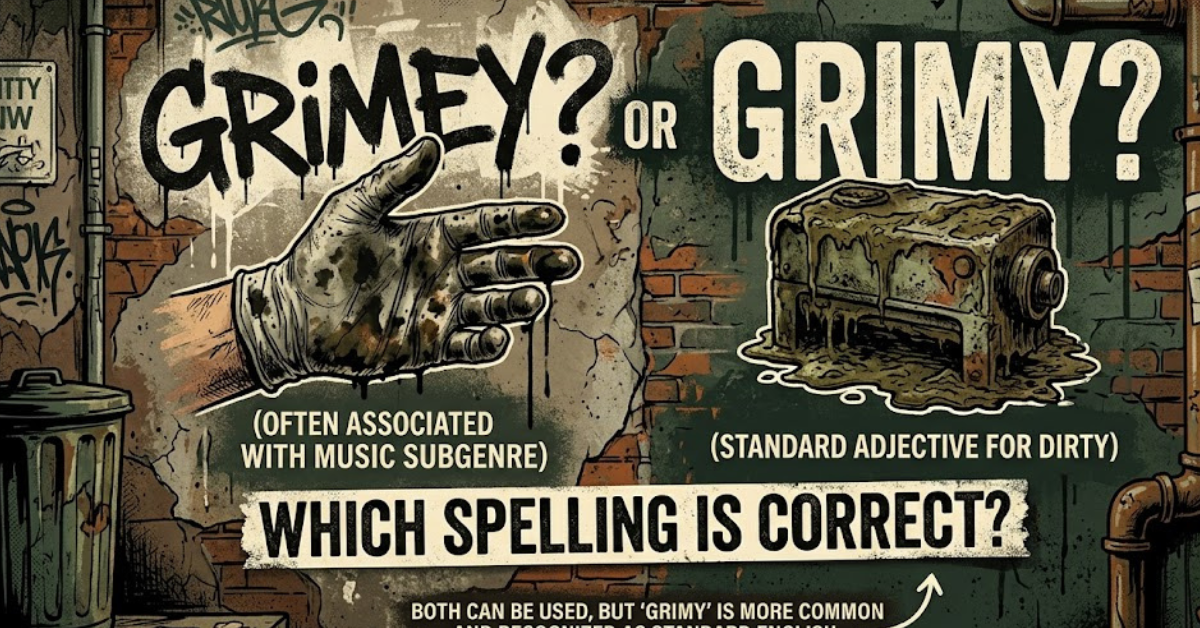
Have you ever typed a word, looked at it twice, and wondered if it was actually correct? That’s exactly what happens with grimey or grimy. Both spellings appear online, in song titles, social media posts, and even published content, leaving many people unsure about which version they should use.
If you’ve been searching for the difference between grimey or grimy, you’re not alone. In this guide, we’ll explore the correct spelling, dictionary definitions, historical usage, common misconceptions, and practical examples so you can use the word confidently in any context.
Understanding the Meaning of Grimy
Before comparing the spellings, it’s important to understand what the word means.
Grimy is an adjective used to describe something that is dirty, covered with grime, or stained by dirt and grease.
Examples:
- A grimy kitchen floor
- Grimy hands after working on a car
- A grimy alleyway in an old industrial district
The word comes from grime, which refers to ingrained dirt, soot, grease, or other filthy substances that accumulate over time.
Dictionary Definition of Grimy
Most major dictionaries define grimy as:
Covered with dirt, soot, grease, or other unpleasant substances.
The term can also be used figuratively to describe something morally questionable or unpleasant.
For example:
- A grimy business deal
- A grimy political scandal
Grimey or Grimy: Which Is Correct?
The standard and widely accepted spelling is grimy.
If you’re writing for:
- School assignments
- Professional documents
- Academic papers
- Business communication
- Journalism
You should use grimy.
Why Does “Grimey” Exist?
The spelling grimey is generally considered a nonstandard variation of grimy. It gained popularity through informal writing, internet culture, music, and slang usage.
In some cases, people spell it grimey because:
- It looks closer to the root word “grime.”
- It reflects a particular style or cultural expression.
- It has been adopted as part of brand names, usernames, or artistic identities.
While grimey is commonly seen online, it is not the preferred dictionary spelling.
The Difference Between Grimey and Grimy
Here’s a simple comparison:
| Feature | Grimy | Grimey |
| Dictionary accepted | Yes | Usually no |
| Formal writing | Recommended | Not recommended |
| Informal internet use | Sometimes | Common |
| Academic usage | Correct | Incorrect |
| Based on standard English | Yes | No |
In everyday communication, most readers will understand both spellings. However, choosing grimy demonstrates adherence to standard English conventions.
How the Word Is Used in Real Life
The popularity of both spellings often depends on context.
Formal Contexts
In professional or academic environments, use grimy.
Examples:
- The workers returned with grimy uniforms.
- The abandoned building had grimy windows.
- The mechanic wiped his grimy hands with a towel.
Informal Contexts
Online communities and social media users sometimes prefer grimey.
Examples:
- That club looks grimey.
- The neighborhood has a grimey underground vibe.
- The artist intentionally used a grimey aesthetic.
These uses often emphasize style, attitude, or cultural identity rather than grammatical accuracy.
Why People Get Confused
Several factors contribute to the confusion between grimey or grimy.
The Root Word Effect
Since the noun is spelled grime, many people naturally assume the adjective should be grimey.
However, English spelling doesn’t always follow a perfectly predictable pattern.
Examples:
- Ice → Icy
- Juice → Juicy
- Spice → Spicy
- Grime → Grimy
The “y” ending follows common English adjective formation rules.
Internet Influence
Search engines, social media platforms, forums, and music culture have increased the visibility of alternative spellings.
When people repeatedly encounter grimey online, they may assume it is equally correct.
Regional and Cultural Usage
Some communities intentionally use grimey to create a distinctive voice or aesthetic. In these cases, the alternative spelling becomes part of a cultural identity rather than a grammatical choice.
Examples of Correct Usage
Here are examples showing how grimy is used correctly.
Physical Dirt
- The old workshop was dark and grimy.
- She cleaned the grimy bathroom tiles.
- His clothes became grimy after working outdoors.
Figurative Meaning
- The company became involved in a grimy legal dispute.
- Reporters uncovered a grimy corruption scheme.
- The novel explores the grimy side of urban life.
Common Mistakes to Avoid
When deciding between grimey or grimy, keep these points in mind.
Avoid Using Grimey in Formal Writing
Although many people recognize it, editors and teachers typically expect the standard spelling.
Don’t Assume Search Volume Equals Correctness
A word appearing frequently online doesn’t automatically make it grammatically standard.
Consider Your Audience
Ask yourself:
- Is this a professional audience?
- Is the content academic?
- Is grammar important in this context?
If the answer is yes, choose grimy.
The Role of Grimy in Popular Culture
The word has evolved beyond simply describing dirt.
Today, grimy can describe:
- Urban environments
- Underground music scenes
- Street culture
- Gritty artistic aesthetics
- Dark storytelling
For example, a filmmaker might intentionally create a grimy visual style to portray realism and hardship.
This broader cultural usage has helped keep alternative spellings like grimey visible in entertainment and social media.
Quick Tips for Remembering the Correct Spelling
If you’re unsure which version to use, remember these simple tips:
- The dictionary spelling is grimy.
- Use grimy in school, work, and professional writing.
- Treat grimey as an informal variation.
- When in doubt, choose grimy.
- Most grammar checkers recognize grimy as the standard form.
Key Takeaways
- Grimy is the correct standard English spelling.
- Grimey is a common informal or stylistic variation.
- Major dictionaries recognize grimy.
- Professional and academic writing should use grimy.
- The confusion often comes from the root word grime and internet usage.
- Both spellings may appear online, but only one is widely accepted in standard English.
Frequently Asked Questions
Is grimey a real word?
Grimey appears in informal writing, social media, and popular culture. However, grimy is the standard dictionary spelling recognized in formal English.
Which spelling should I use: grimey or grimy?
For most situations, use grimy. It is the accepted spelling in professional, educational, and published writing.
Why do people spell grimy as grimey?
Many people connect the adjective to the root word grime and assume the spelling should remain unchanged. Others use grimey as a stylistic choice.
Is grimey grammatically incorrect?
In standard English, grimey is generally considered nonstandard. While readers may understand it, editors typically prefer grimy.
Does grimy only mean dirty?
No. Besides describing physical dirt, grimy can also refer to something morally questionable, unpleasant, or gritty in appearance and atmosphere.
Is grimey used in music and slang?
Yes. Various artists, online communities, and cultural movements use grimey intentionally as part of a particular aesthetic or identity.
Conclusion
When comparing grimey or grimy, the answer is straightforward: grimy is the correct and widely accepted spelling in standard English. While grimey appears frequently in slang, online culture, and artistic branding, it remains a nonstandard variation.
Understanding the distinction helps you communicate more clearly and confidently, whether you’re writing an email, creating content, or simply settling a spelling debate. The next time you encounter the question of grimey or grimy, you’ll know exactly which spelling belongs in formal writing—and why the alternative continues to show up across the internet.
Leave a Reply