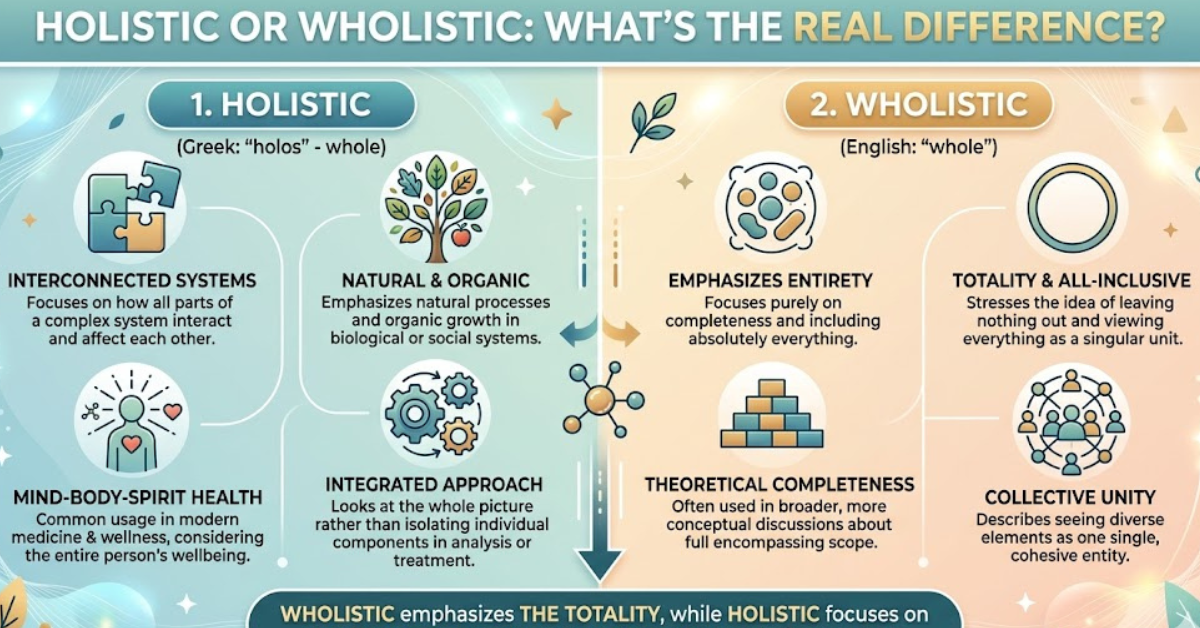
Have you ever come across the terms holistic and wholistic and wondered whether they mean the same thing—or if one is actually more correct than the other?
The debate around Holistic or Wholistic has become increasingly common, especially in wellness, healthcare, education, coaching, and personal development circles. While both words are often used interchangeably, there are subtle differences in history, perception, and usage that are worth understanding.
In this guide, you’ll discover the origins of both terms, their meanings, when to use each one, and why the distinction matters in modern communication. Whether you’re a writer, practitioner, student, or simply curious, this article will help you navigate the topic with confidence.
Understanding the Meaning of Holistic and Wholistic
At their core, both terms refer to the idea that something should be viewed as an interconnected whole rather than as separate parts.
A holistic approach considers the complete picture instead of focusing on individual components in isolation.
For example:
- A holistic doctor may examine physical, emotional, and lifestyle factors.
- A holistic teacher may consider a student’s academic, social, and emotional development.
- A holistic business strategy looks at long-term organizational health rather than isolated metrics.
The central principle is simple: the whole is greater than the sum of its parts.
The Origin of the Word Holistic
Where Did “Holistic” Come From?
The word holistic originates from the term holism, introduced by South African philosopher and statesman Jan Smuts in his 1926 book Holism and Evolution.
Smuts described holism as a natural tendency for systems to form integrated wholes that are more meaningful than their individual parts.
Over time, the term spread into fields such as:
- Medicine
- Psychology
- Education
- Ecology
- Organizational leadership
- Personal development
Today, “holistic” is the standard dictionary-recognized spelling and is widely accepted in academic and professional contexts.
What Does Wholistic Mean?
The Emergence of “Wholistic”
The word wholistic developed later as an alternative spelling that emphasizes the word whole.
Supporters of this spelling argue that it immediately highlights the concept of completeness and integration.
Although “wholistic” carries essentially the same meaning as “holistic,” it is more commonly seen in:
- Alternative health practices
- Spiritual communities
- Wellness coaching
- Mind-body healing programs
Many organizations use “wholistic” intentionally because they feel it communicates a stronger connection to personal wholeness.
Holistic or Wholistic: Are They Different?
The Short Answer
In most situations, there is no significant difference in meaning between holistic and wholistic.
Both describe an approach that considers all aspects of a person, system, or situation.
However, there are differences in perception and usage.
| Aspect | Holistic | Wholistic |
| Dictionary Recognition | Standard | Alternative |
| Academic Use | Common | Rare |
| Medical Literature | Widely Used | Limited |
| Wellness Industry | Common | Common |
| Spiritual Communities | Less Common | More Common |
| Professional Acceptance | High | Moderate |
Why Some People Prefer “Wholistic”
Those who choose “wholistic” often want to emphasize:
- Personal completeness
- Mind-body-spirit integration
- Human interconnectedness
- Healing beyond physical symptoms
The spelling itself reinforces the concept of becoming “whole.”
Why Holistic Is More Common
Standard Language Usage
Most dictionaries, universities, healthcare organizations, and professional institutions prefer holistic.
Examples include:
- Holistic healthcare
- Holistic education
- Holistic development
- Holistic assessment
- Holistic management
When writing for broad audiences, professional publications, or academic settings, holistic is generally the safer choice.
Search and Recognition Advantages
Because holistic is the more established term:
- More people search for it online
- It appears more frequently in research papers
- It is more familiar to general audiences
- Search engines recognize it more consistently
For businesses and content creators, using “holistic” often improves clarity and discoverability.
Holistic Thinking in Everyday Life
A holistic perspective extends far beyond healthcare.
Health and Wellness
Instead of focusing solely on symptoms, holistic health considers:
- Nutrition
- Exercise
- Sleep quality
- Stress levels
- Emotional wellbeing
- Environmental influences
Education
Holistic education aims to develop:
- Intellectual abilities
- Emotional intelligence
- Creativity
- Social skills
- Character development
Business and Leadership
Holistic leaders evaluate:
- Employee wellbeing
- Company culture
- Customer satisfaction
- Financial performance
- Long-term sustainability
This broader viewpoint often leads to better decision-making.
Common Examples of Holistic Approaches
Holistic Healthcare
Healthcare professionals may combine:
- Conventional medicine
- Nutritional guidance
- Stress management
- Preventive care
- Lifestyle modifications
Holistic Nutrition
Rather than counting calories alone, practitioners may examine:
- Food quality
- Eating habits
- Sleep patterns
- Physical activity
- Emotional relationships with food
Holistic Personal Development
This approach encourages growth across multiple dimensions:
- Physical health
- Mental wellbeing
- Emotional resilience
- Relationships
- Purpose and fulfillment
When Should You Use Holistic?
Use holistic when:
- Writing professionally
- Creating academic content
- Publishing healthcare materials
- Communicating with broad audiences
- Following standard language conventions
Examples:
- Holistic healthcare model
- Holistic business strategy
- Holistic educational framework
- Holistic patient care
In most formal settings, holistic is the preferred option.
When Should You Use Wholistic?
Use wholistic when:
- Referring to a brand that uses the spelling
- Writing for specific wellness communities
- Emphasizing personal wholeness
- Matching terminology already used by an organization
Examples:
- Wholistic healing programs
- Wholistic wellness coaching
- Wholistic lifestyle practices
The choice is often stylistic rather than semantic.
Common Misconceptions About Holistic and Wholistic
Myth 1: Wholistic Is More Correct
Neither spelling is inherently more correct in terms of meaning. However, holistic is the standard and more widely accepted form.
Myth 2: They Represent Different Philosophies
In most contexts, both terms describe the same underlying concept: considering the whole rather than isolated parts.
Myth 3: Holistic Means Alternative Medicine Only
Holistic thinking applies across numerous disciplines, including education, business, psychology, environmental science, and leadership.
Myth 4: Holistic Ignores Science
Many evidence-based healthcare systems incorporate holistic principles while maintaining rigorous scientific standards.
Key Benefits of a Holistic Perspective
Adopting a holistic mindset can provide several advantages:
- Better problem-solving
- Improved decision-making
- Greater self-awareness
- Enhanced long-term outcomes
- Stronger connections between different factors
- More sustainable solutions
Whether addressing health, education, or business challenges, considering the bigger picture often leads to deeper insights.
Practical Tips for Choosing the Right Term
If you’re unsure which spelling to use, follow these guidelines:
Choose Holistic If:
- You want maximum clarity.
- You’re writing for a professional audience.
- You want standard dictionary usage.
Choose Wholistic If:
- You’re aligning with a specific brand identity.
- Your audience is familiar with wellness terminology.
- You want to emphasize the idea of becoming whole.
For most situations, holistic remains the preferred choice.
Key Takeaways
- Holistic and wholistic generally mean the same thing.
- Holistic is the original and more widely accepted spelling.
- Wholistic emerged to emphasize the concept of wholeness.
- Professional, academic, and healthcare settings typically favor holistic.
- Wellness and spiritual communities may prefer wholistic.
- The difference is largely stylistic rather than conceptual.
Frequently Asked Questions
Is holistic or wholistic correct?
Both are considered correct, but holistic is the standard spelling recognized by most dictionaries, academic institutions, and professional organizations.
What is the difference between holistic and wholistic?
The meanings are nearly identical. The primary difference is that wholistic intentionally emphasizes the word “whole,” while holistic is the traditional and more common spelling.
Why do some wellness practitioners use wholistic?
Many practitioners use wholistic to highlight complete mind-body-spirit integration and the concept of personal wholeness.
Is wholistic a real word?
Yes. Wholistic is recognized as an alternative spelling, though it is far less common than holistic in mainstream usage.
Which term is better for business or professional writing?
Holistic is generally the better choice because it is more widely recognized, understood, and accepted across industries.
Does holistic only refer to health?
No. Holistic approaches are used in education, psychology, business, leadership, environmental studies, and many other fields.
Conclusion
The discussion around Holistic or Wholistic often creates more confusion than necessary because the two terms share essentially the same meaning. Both emphasize viewing people, systems, and situations as interconnected wholes rather than isolated parts.
That said, holistic remains the standard and most widely accepted spelling across professional, academic, and healthcare environments. Wholistic serves as an alternative that places additional emphasis on the idea of wholeness, making it popular in certain wellness and spiritual communities.
Understanding the distinction allows you to choose the right term for your audience and purpose. Whether you’re exploring health, education, personal growth, or business strategy, adopting a holistic perspective can help you see the bigger picture and make more informed decisions.
Leave a Reply