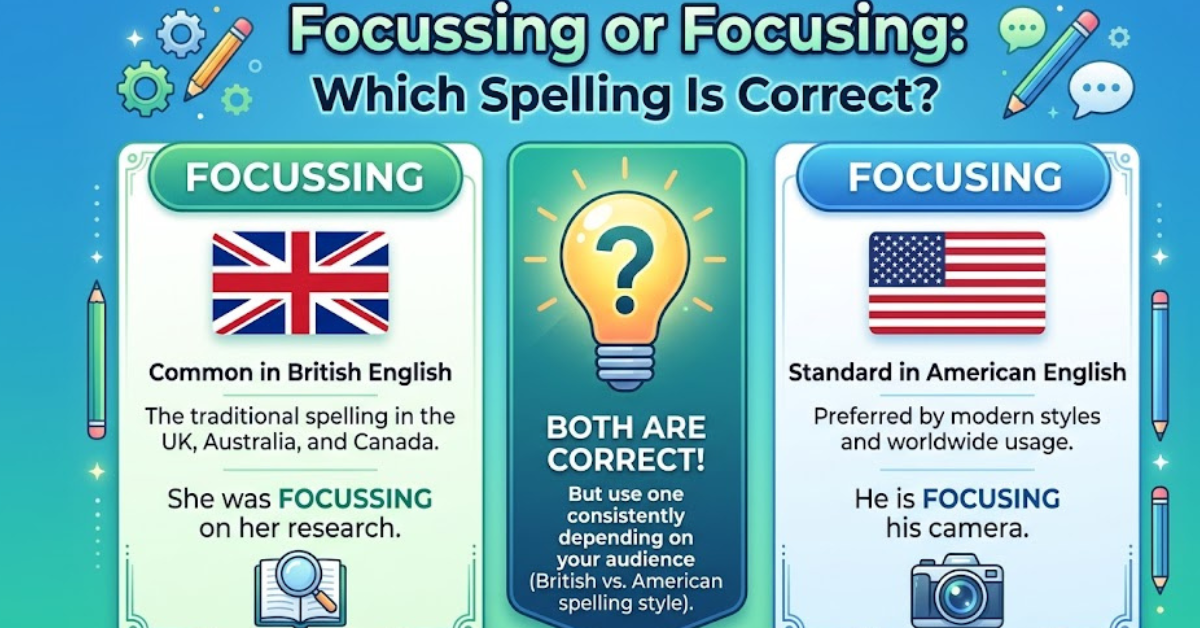
Have you ever paused while writing and wondered whether it should be focussing or focusing? You’re not alone. This is one of the most common spelling questions in English, especially for writers, students, professionals, and content creators.
The confusion comes from differences between British and American English, as well as changing language conventions over time. In this guide, you’ll learn which spelling is correct, where each version is used, the grammar behind the word, and how to choose the right form for your audience.
Understanding the Difference Between Focussing and Focusing
At first glance, the two spellings look almost identical. The only difference is the double “s” in focussing.
- Focusing = Most widely accepted modern spelling
- Focussing = Alternative spelling, mainly found in some British English contexts
Today, focusing is considered the standard spelling by most dictionaries, style guides, publishers, and educational institutions worldwide.
Quick Answer
If you’re unsure which version to use, choose focusing.
It is:
- Preferred in American English
- Commonly accepted in British English
- Recommended by many modern style guides
- More frequently used in books, websites, and professional writing
Why Is There Confusion?
The confusion stems from traditional English spelling rules.
When adding suffixes such as -ing to words ending in a consonant, English sometimes doubles the final consonant.
For example:
- Run → Running
- Sit → Sitting
- Begin → Beginning
Some writers applied the same logic to focus, resulting in focussing.
However, modern usage has largely standardized the spelling as focusing, making it the dominant form in contemporary English.
Which Spelling Do Major Dictionaries Prefer?
Most authoritative dictionaries recognize both forms but prioritize focusing.
Merriam-Webster
Lists focusing as the preferred spelling.
Oxford English Dictionary
Accepts both spellings but notes that focusing is increasingly dominant.
Cambridge Dictionary
Primarily uses focusing.
Collins Dictionary
Recognizes both but often favors focusing in modern examples.
The trend across major language references is clear: focusing has become the standard choice.
Focusing in American English
In American English, the answer is straightforward.
Standard Usage
Americans almost exclusively use:
- Focus
- Focused
- Focusing
Examples:
- The team is focusing on customer satisfaction.
- She is focusing on her final exams.
- The camera is focusing automatically.
Using focussing in American publications may appear unusual or outdated.
Focusing vs Focussing in British English
British English allows slightly more flexibility.
Historically, some British writers preferred focussing because it followed traditional consonant-doubling patterns.
However, modern British publishers increasingly use focusing.
Current Trend
Today, you’ll often see:
- Focusing (more common)
- Focussing (less common but still accepted)
Many UK newspapers, academic journals, and businesses now favor the single-s spelling.
Why Has Focusing Become More Popular?
Language evolves based on usage.
Several factors have contributed to the rise of focusing:
1. Global Standardization
As international communication has expanded, publishers often choose one consistent spelling that works across regions.
2. Digital Writing
Search engines, websites, and online publications overwhelmingly use focusing, reinforcing its popularity.
3. Style Guide Preferences
Editorial standards increasingly recommend the simpler spelling.
4. Reader Familiarity
Most readers encounter focusing far more often than focussing, making it feel more natural.
Grammar Rule Behind the Word
To understand the spelling difference, it helps to examine the word structure.
The word focus comes from Latin and ends in:
- Vowel + consonant + vowel sound pattern
Traditional spelling rules don’t always apply neatly to words borrowed from other languages.
Adding “-ing”
When forming the present participle:
- Focus → Focusing
Modern English generally treats focus as a word that does not require doubling the final consonant before adding -ing.
The same principle applies to:
- Focused
- Focusing
- Focuses
Examples of Correct Usage
Here are some natural examples using the preferred spelling.
In Business
“Our company is focusing on improving customer experience.”
In Education
“Students should be focusing on understanding concepts rather than memorizing facts.”
In Sports
“The athlete is focusing on strength and endurance training.”
In Photography
“The camera lens is focusing on the subject automatically.”
In Personal Development
“Many people are focusing on work-life balance more than ever before.”
Focusing in Professional and Academic Writing
If you write professionally, consistency matters.
Most organizations recommend using focusing because it:
- Aligns with modern style standards
- Looks familiar to global audiences
- Matches common dictionary recommendations
- Improves consistency across documents
Best Practice
Choose one spelling and use it consistently throughout a document.
For most audiences, focusing is the safest option.
Common Mistakes to Avoid
Mixing Both Spellings
Incorrect:
- The report is focusing on sales growth.
- The next section discusses focussing on retention.
Correct:
- The report is focusing on sales growth.
- The next section discusses focusing on retention.
Assuming Focussing Is Always Wrong
While less common, focussing is still accepted in some British English contexts.
Ignoring Audience Expectations
Consider who will read your content.
- International audience → Focusing
- American audience → Focusing
- British audience → Usually focusing, occasionally focussing
Focusing in Search Engines and Online Content
For bloggers, marketers, and website owners, spelling choice can affect consistency and user expectations.
A quick analysis of online content shows that focusing appears far more frequently across:
- News websites
- Educational resources
- Corporate blogs
- Academic publications
- Search engine results
This widespread usage makes it the preferred choice for digital communication.
Quick Comparison Table
| Feature | Focusing | Focussing |
| American English | Standard | Rare |
| British English | Common | Accepted but less common |
| Modern Style Guides | Preferred | Less preferred |
| Academic Writing | Recommended | Less common |
| Business Writing | Recommended | Rare |
| Online Content | Dominant | Limited use |
Key Takeaways
- Focusing is the most widely accepted spelling today.
- American English strongly prefers focusing.
- British English accepts both forms, but focusing is increasingly common.
- Major dictionaries and style guides favor focusing.
- Professional, academic, and online writing generally use the single-s version.
- Consistency is more important than switching between spellings.
Frequently Asked Questions
Is focussing or focusing correct?
Both spellings are technically correct, but focusing is the preferred and more widely accepted form in modern English.
Why do some people write focussing?
Some writers follow older British spelling conventions that double the consonant before adding “-ing.” This results in focussing.
Which spelling should I use in professional writing?
Use focusing. It is the standard choice in business, academic, and digital communication.
Is focussing considered wrong?
Not necessarily. It is still recognized by some dictionaries, particularly in British English, though it is much less common today.
Do search engines prefer focusing or focussing?
Search engines understand both forms, but focusing appears far more frequently in online content and search results.
What is the correct spelling in the UK?
Both spellings are accepted in the UK, but focusing has become increasingly dominant in modern British publishing.
Conclusion
The debate over focussing or focusing is largely a matter of spelling convention rather than strict correctness. While both versions exist, focusing has emerged as the modern standard across American English, international publications, business writing, academic work, and digital content.
If you’re writing for a broad audience and want the safest, most widely recognized option, choose focusing. It aligns with current language trends, major dictionaries, and reader expectations. By understanding the distinction and using the spelling consistently, you can write with greater confidence and clarity.
Leave a Reply