One of the most common spelling confusions in English is occassion or occasion. If you’ve ever paused while writing and wondered which one is correct, you’re not alone. This small but important word often trips up students, writers, and even professionals.
The correct spelling is occasion, and understanding why it’s spelled this way can improve your writing accuracy and boost your confidence in English. In this guide, we’ll break down the correct usage, common mistakes, real examples, and simple memory tricks to help you never get it wrong again.
Occasion or Occassion – Which Spelling is Correct?
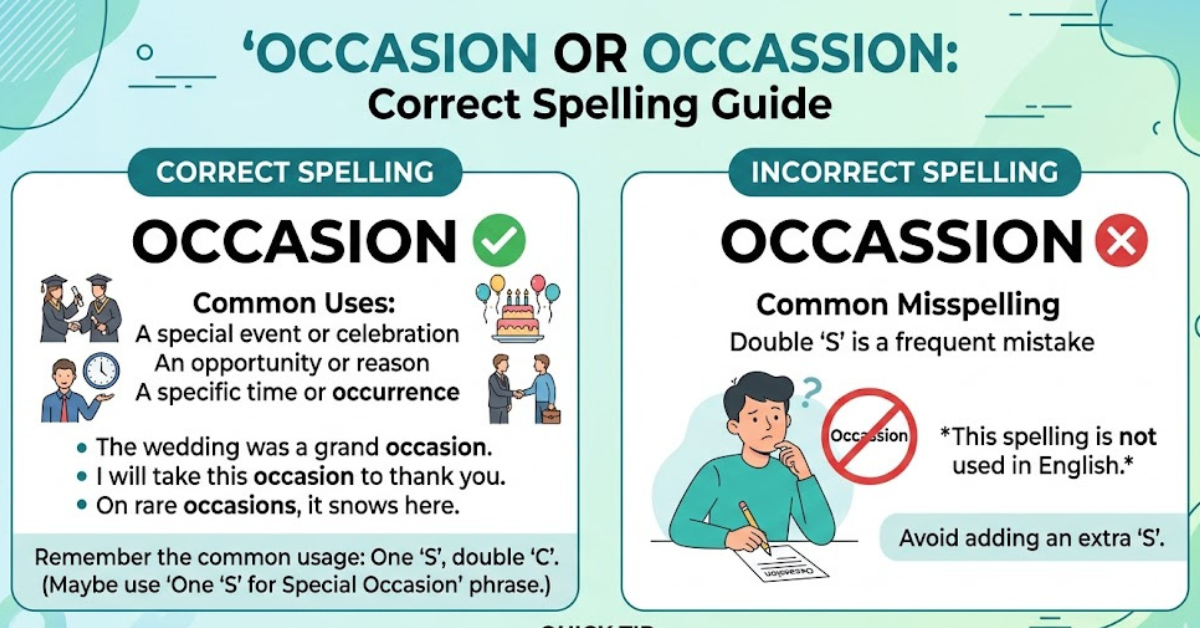
The correct spelling is occasion, not occassion.
The mistake happens because many English words double consonants, so people assume “occasion” should also have two “s” letters. However, in standard English spelling, it only has one c and one s in the middle.
Correct:
- Occasion
Incorrect:
- Occassion
Meaning of the Word “Occasion”
The word occasion is used in English to describe a special event, moment, or reason for something.
Common meanings include:
- A special event or celebration
- A particular time when something happens
- A reason or cause for an action
Example sentences:
- It was a joyful occasion for the whole family.
- On this occasion, we decided to celebrate differently.
- There is no occasion to worry about it.
Why “Occassion” is a Common Misspelling
The incorrect form occassion usually appears because of:
1. Double letter confusion
English words like “profession” or “possession” have double letters, so writers overgeneralize the rule.
2. Pronunciation influence
Since “occasion” is spoken with emphasis in the middle, people assume extra letters exist.
3. Typing habits
Fast typing often leads to accidental duplication of letters.
Easy Ways to Remember the Correct Spelling
Here are some simple tricks to help you always write it correctly:
Memory tips:
- Think: “One occasion, one celebration” → one “s”
- Break it down: oc + ca + sion
- Remember: “No double trouble in occasion”
Quick rule:
If you’re unsure, always check for single “c” and single “s” in the middle.
Common Uses of “Occasion” in Daily English
The word is widely used in both formal and informal English.
Everyday usage:
- Birthday occasion
- Wedding occasion
- Special occasion
- Formal occasion
Phrases:
- “On this occasion”
- “A rare occasion”
- “Mark the occasion”
- “Occasion of celebration”
Occasion in Formal vs Informal Writing
Formal writing:
- Used in essays, business emails, reports
- Example: This report is prepared on the occasion of the annual meeting.
Informal writing:
- Used in conversations, social media, captions
- Example: What a great occasion to hang out with friends!
FAQs About Occasion or Occassion
1. What is the correct spelling, occasion or occassion?
The correct spelling is occasion. “Occassion” is incorrect.
2. Why do people spell occasion as occassion?
Because of confusion with other English words that use double letters.
3. What does occasion mean in English?
It means a special event, moment, or reason for something.
4. How can I remember the spelling of occasion?
Remember it has only one “c” and one “s” in the middle: o-c-c-a-s-i-o-n.
5. Is occasion a formal word?
Yes, it is used in both formal and informal English contexts.
Conclusion
The confusion between occassion or occasion is very common, but the correct spelling is always occasion. Once you remember that it uses only one “s” and one “c” in the middle, you’ll avoid one of the most frequent English spelling mistakes.
Whether you’re writing an essay, a caption, or a professional email, using the correct spelling improves clarity and credibility. Keep practicing, and soon it will become second nature.
Leave a Reply