Have you ever paused mid-writing and wondered whether it’s Sleave or Sleeve? You’re not alone—this is one of those confusing word pairs that looks similar but carries very different meanings depending on context.
The confusion between Sleave or Sleeve often comes from spelling similarity and historical language changes in English. In this guide, you’ll learn what each term means, why the confusion exists, how to use them correctly, and practical tricks to remember the difference.
By the end, you’ll confidently understand when to use each form without second-guessing yourself.
What Does “Sleave or Sleeve” Mean?
At first glance, Sleave or Sleeve might look like simple spelling variations of the same word, but they are actually distinct in origin and meaning.
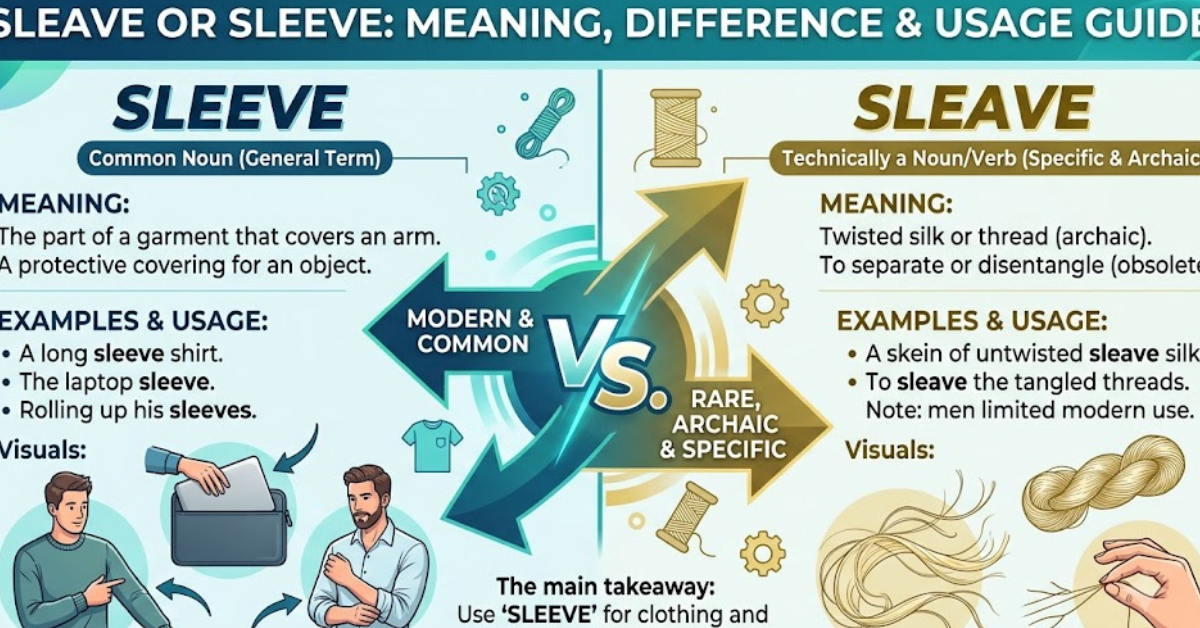
The word “sleeve” is the modern and widely used term referring to the part of a garment that covers the arm. Meanwhile, “sleave” is an older, less common English word that historically referred to untwisted or loosely tangled thread or silk.
In modern usage, when people search Sleave or Sleeve, they are usually trying to clarify spelling or understand whether both are correct. The short answer: only sleeve is commonly correct today.
Sleeve vs Sleave: Key Differences
Understanding the distinction between these two terms requires looking at language evolution.
1. Sleeve (Modern Usage)
- Refers to clothing (shirt sleeve, jacket sleeve)
- Common in everyday English
- Used in fashion, tailoring, and design
2. Sleave (Archaic Usage)
- Refers to tangled or unwoven thread
- Found in older English texts and poetry
- Rare in modern communication
When comparing Sleave or Sleeve, it’s clear that “sleeve” dominates modern language, while “sleave” survives mainly in historical or literary contexts.
Common Confusion and Why It Happens
The confusion between Sleave or Sleeve happens for a few reasons.
First, English spelling has evolved over centuries, and older words like “sleave” have mostly faded out of everyday use. Second, pronunciation is nearly identical, which makes spelling harder to distinguish.
Many learners searching for Sleave or Sleeve assume they are interchangeable, but they are not. The modern spelling “sleeve” is the one you’ll encounter in clothing labels, dictionaries, and digital content.
Another reason the confusion persists is auto-correct and informal writing, which sometimes blur the line between Sleave or Sleeve in online searches.
Proper Usage in Modern English
To use these words correctly, context is everything.
Correct Usage of Sleeve
- “The shirt has long sleeves.”
- “She rolled up her sleeve before the injection.”
- “The laptop sleeve protects the device.”
Historical Usage of Sleave
- “The silk was left in a sleave of tangled threads.”
- Found mostly in classical poetry or literature
When you encounter Sleave or Sleeve in modern writing, 99% of the time, “sleeve” is the intended word.
In fact, even professional writing style guides recommend avoiding Sleave or Sleeve confusion entirely by sticking with “sleeve” unless referencing historical texts.
Etymology of Sleeve and Sleave
The word “sleeve” originates from Old English sliefe, which referred to the garment part covering the arm. Over time, spelling standardized into “sleeve.”
On the other hand, “sleave” comes from Middle English and was used to describe loose silk or untwisted fibers. As English evolved, this meaning became obsolete.
So when people debate Sleave or Sleeve, they are essentially looking at two words that share linguistic roots but diverged in meaning centuries ago.
Practical Tips to Remember the Difference
If you ever get stuck on Sleave or Sleeve, these quick tips can help:
- Think “sleeve = shirt” (modern clothing always uses sleeve)
- Remember “sleave = scrap thread” (rare, historical)
- If writing for school, business, or online content, always choose “sleeve”
- When in doubt, check if the context is fashion or fabric—if yes, it’s sleeve
These simple memory tricks make it easy to avoid confusion between Sleave or Sleeve.
Key Takeaways
- “Sleeve” is the correct modern spelling for clothing and accessories
- “Sleave” is an archaic term meaning tangled thread
- The confusion exists due to historical language changes
- In almost all modern contexts, “sleeve” is the right choice
FAQs
1. Is it Sleave or Sleeve in modern English?
The correct modern spelling is “sleeve.” “Sleave” is rarely used today except in historical or literary contexts.
2. What does sleave mean?
“Sleave” refers to loose, untwisted silk or thread, mostly found in older English writing.
3. Why do people confuse Sleave or Sleeve?
They sound identical and have very similar spellings, but only “sleeve” is commonly used today.
4. Can I use sleave instead of sleeve?
No, not in modern writing. Always use “sleeve” unless quoting historical text.
5. Is sleeve only related to clothing?
No, it can also refer to protective covers like a laptop sleeve or document sleeve.
6. Which is more common: Sleave or Sleeve?
“Sleeve” is overwhelmingly more common and is the standard spelling in modern English.
Conclusion
The debate around Sleave or Sleeve is less about competition and more about language evolution. While “sleave” belongs to older English and literary history, “sleeve” remains the standard in everyday communication, fashion, and modern writing.
Understanding this distinction helps you write more confidently and avoid common spelling mistakes. The next time you encounter Sleave or Sleeve, you’ll know exactly which one fits the context—and why it matters.
If you’re exploring more confusing word pairs, keep learning; English is full of surprises that make language both challenging and fascinating.
Leave a Reply