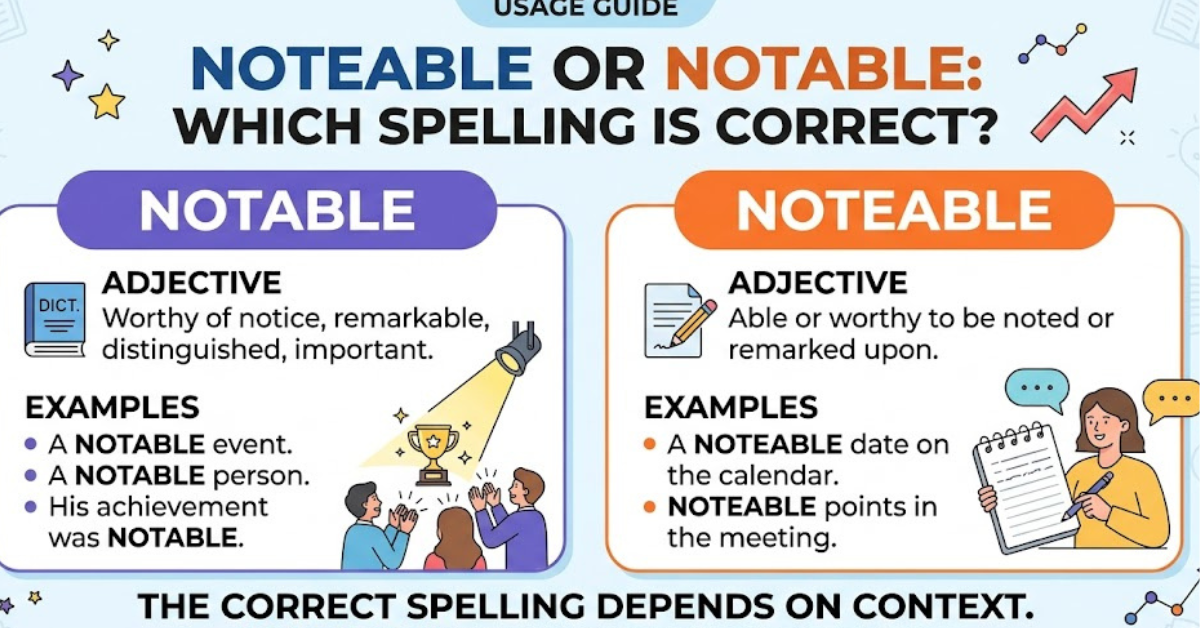
Have you ever paused while writing and wondered whether it should be Noteable or Notable? You’re not alone—this is one of those English spelling doubts that trips up even confident writers.
The confusion between Noteable or Notable often comes from how the word sounds when spoken. In this guide, we’ll break down the correct spelling, meaning, usage rules, and real-world examples so you never hesitate again. You’ll also learn why the mistake happens so frequently and when, if ever, “noteable” is actually used.
What Is Correct: Noteable or Notable?
The correct spelling is notable, not noteable.
So when comparing Noteable or Notable, the answer is clear:
- Correct: Notable
- Incorrect (standard usage): Noteable
The word notable is widely accepted in formal writing, academic English, journalism, and everyday communication. It means something or someone worthy of attention or recognition.
Meaning of “Notable” in English
To fully understand Noteable or Notable, you need to understand what notable actually means.
Definition of Notable:
Notable is an adjective used to describe something important, remarkable, or worthy of attention.
Examples of usage:
- She made a notable contribution to science.
- The city has several notable historical landmarks.
- There was a notable improvement in his performance.
Synonyms of Notable:
- Remarkable
- Significant
- Prominent
- Distinguished
- Worth mentioning
This is why Notable is the correct spelling—it comes from the Latin root notabilis, meaning “worthy of note.”
Why Do People Confuse Noteable or Notable?
The confusion between Noteable or Notable happens for a few simple reasons:
1. Pronunciation Influence
People naturally hear “note-able,” which makes the spelling noteable seem logical.
2. English Spelling Patterns
English often adds “-able” to words (like “manageable” or “comfortable”), so users assume note + able = noteable.
3. Lack of Visual Familiarity
Since notable is less frequently broken down into syllables in speech, learners often miswrite it.
4. Digital Typos
Autocorrect and fast typing also contribute to the spread of the incorrect form.
Is “Noteable” Ever Correct?
While Noteable or Notable clearly favors notable in standard English, there is a small exception worth mentioning.
“Noteable” as a Proper Name
- Noteable is used as a brand name in some contexts, such as Noteable (a collaborative data science platform).
- In branding, spelling rules are flexible and intentional.
However, outside of proper nouns or branding, noteable is considered incorrect in standard English writing.
Real-World Examples of “Notable”
To fully master Noteable or Notable, seeing it in context helps.
Business & Media
- The company reported a notable increase in revenue this quarter.
Education
- She is a notable researcher in environmental science.
Technology
- There was a notable shift toward AI-driven tools in 2026.
Everyday Writing
- The restaurant is notable for its unique fusion cuisine.
Quick Tips to Remember the Correct Spelling
Here are simple tricks to avoid the Noteable or Notable mistake:
- Think: “worthy of note” → drop the “e”
- Remember: notable = note + able (but shortened form)
- Associate it with “noticeable” (similar meaning, different spelling pattern)
- Rely on memory: only one “o” after “n”
Key Takeaways
- The correct spelling is notable
- Noteable is usually incorrect in standard English
- The confusion comes from pronunciation and spelling assumptions
- “Notable” means remarkable or worthy of attention
- Only use Noteable if referring to a specific brand name
FAQ: Noteable or Notable
1. What is correct, Noteable or Notable?
The correct spelling is notable. “Noteable” is generally considered a spelling error in standard English.
2. Why do people write Noteable or Notable incorrectly?
Most people write noteable because it sounds like it should include “note + able,” but the correct form is historically derived as “notable.”
3. Is Noteable ever acceptable in writing?
Only in rare cases like brand names or product titles. In formal writing, always use notable.
4. What does Notable mean in simple words?
It means something or someone important, remarkable, or worthy of attention.
5. How can I remember the correct spelling of Notable?
Think of the phrase “worthy of note.” That will help you remember that notable is the correct form.
6. Is Notable a formal word?
Yes, notable is commonly used in academic, professional, and journalistic writing.
Conclusion
The debate around Noteable or Notable is a common English confusion, but the answer is straightforward: notable is the correct and standard spelling. Understanding its meaning, origin, and usage not only improves your writing accuracy but also strengthens your overall language confidence.
Now that you know the difference, you can confidently use notable in essays, emails, articles, and professional communication without second-guessing yourself.
Leave a Reply