Ever noticed how a loan statement says “monthly installments” while a UK website writes “instalments” for the same thing? That small spelling difference often confuses writers, students, and even professionals.
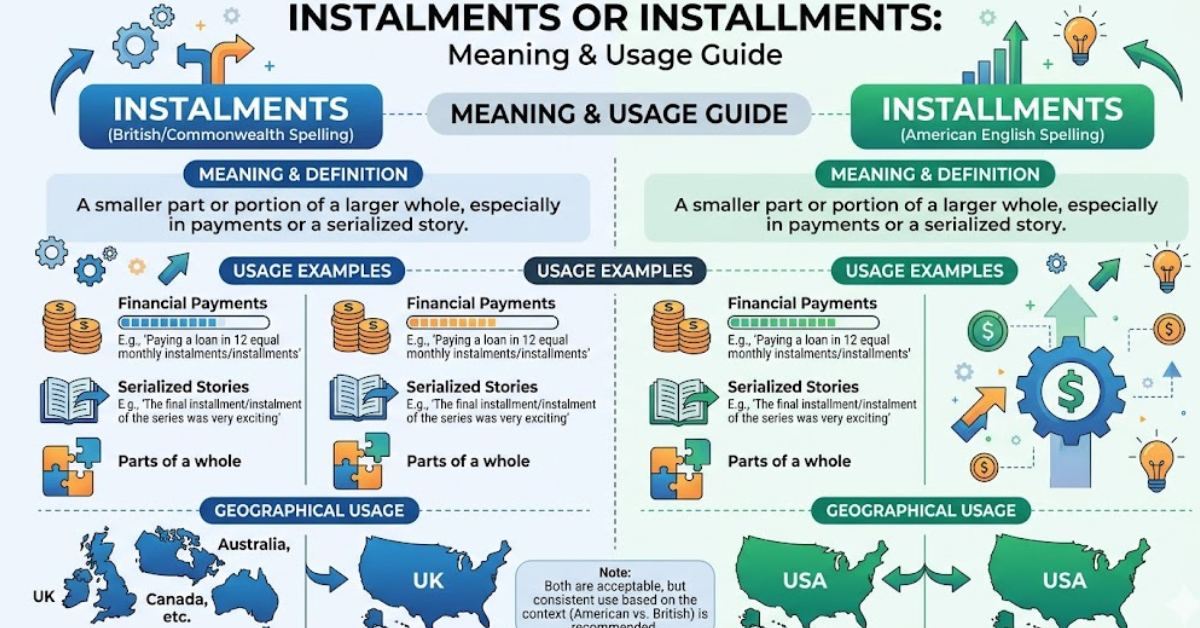
The term instalments or installments refers to dividing a total payment into smaller, scheduled amounts over time. In this guide, you’ll learn what the word means, why two spellings exist, where each is used, and how to choose the correct version depending on your audience.
What Do Instalments or Installments Mean?
At its core, both spellings describe the same financial concept: paying a large amount in smaller, manageable parts over a fixed period.
These payments are commonly used in:
- Loans (personal loans, car loans, mortgages)
- EMI (Equated Monthly Installments)
- Buy Now Pay Later (BNPL) services
- Subscription or billing plans
In simple terms, instalments or installments make expensive purchases more affordable by breaking them into scheduled payments.
For example, instead of paying $1,200 at once, you might pay $100 every month for a year.
Why Are There Two Spellings?
The difference comes down to regional English variations.
British English: “Instalments”
In the UK, Australia, and most Commonwealth countries, the spelling “instalments” is preferred. It follows older English conventions, where simpler spellings are commonly used.
American English: “Installments”
In the United States, the double “l” version “installments” is standard. American English often uses slightly different spelling rules influenced by historical language reforms.
So, neither is wrong—context decides which one you should use.
Where Are Instalments or Installments Used?
The concept appears in many financial and everyday systems. Understanding this helps you see why the term is so widely searched.
1. Banking and Loans
Banks use installment-based repayment structures for:
- Home loans (mortgages)
- Car financing
- Personal loans
2. Retail and Buy Now Pay Later BNPL
Platforms like Klarna or Afterpay allow shoppers to split payments into smaller installments, often interest-free if paid on time.
3. Credit Systems
Credit cards also rely on minimum payment structures that resemble installment plans when balances are carried forward.
4. Utility and Service Billing
Some service providers allow customers to pay bills in structured instalments or installments, especially for high-cost services.
Common Mistakes People Make
Even though the concept is simple, confusion still happens:
- Mixing UK and US spelling in the same document
- Using “installments” in formal British academic writing
- Assuming one spelling is more “correct” than the other
- Confusing instalments with interest rates or fees
A good rule: consistency matters more than preference.
Example Sentences
Here are a few natural uses in context:
- You can pay for the laptop in monthly installments.
- The university allows tuition fees in three instalments.
- He cleared his loan in 24 equal installments.
These examples show how flexible the term is in everyday financial language.
Key Takeaways
- Both spellings mean the same thing: split payments over time
- “Instalments” = British English
- “Installments” = American English
- Used widely in loans, EMI, and BNPL systems
- Consistency is more important than preference in writing
FAQs
1. Are instalments or installments the same thing?
Yes, both refer to divided payments made over time. The meaning is identical, only the spelling differs by region.
2. Which spelling is correct: instalments or installments?
Both are correct. “Instalments” is British English, while “installments” is American English.
3. Why does EMI use installments?
EMI stands for Equated Monthly Installment, commonly used in banking and finance to simplify loan repayment into fixed amounts.
4. Can I use both spellings in one article?
It’s not recommended. Choose one based on your audience and stick to it for consistency and better readability.
5. Are installments interest-free?
Not always. Some BNPL services offer interest-free installments, but loans and credit-based plans may include interest.
6. What is the difference between instalments and lump sum payment?
A lump sum is a single full payment, while instalments or installments split the total amount into smaller scheduled payments.
Conclusion
Whether you say instalments or installments, the concept remains the same: making payments more manageable by spreading them over time. The only real difference lies in regional spelling preferences, not meaning.
Understanding this helps you write more clearly, choose the right version for your audience, and avoid unnecessary confusion in both financial and everyday contexts. If you deal with payments, loans, or digital finance platforms, this small detail can make your communication more accurate and professional.
Leave a Reply