Have you ever seen the words Ingage and Engage used interchangeably and wondered if they mean the same thing—or if one is even correct? You’re not alone. The confusion around Ingage vs Engage is surprisingly common, especially in marketing, sales tools, and everyday communication.
Within the first look, Ingage vs Engage seems like a simple spelling issue, but there’s actually more to it. One is often a misspelling or brand-specific term, while the other is a widely used English verb and business concept. In this guide, you’ll learn the difference, where each term is used, and why it matters in real-world contexts like marketing platforms, presentations, and customer engagement strategies.
Understanding the Basics of Ingage vs Engage
To clear the confusion around Ingage vs Engage, we need to separate language from branding.
What does “Engage” mean?
“Engage” is a standard English word. It has several meanings depending on context:
- To attract or hold attention
- To participate or become involved
- To interact with customers or audiences
- To hire or employ someone
In business and marketing, “engagement” is a key metric. It measures how people interact with content, products, or services.
For example:
- A brand tries to engage customers through social media
- Teachers engage students in learning
- Websites aim to increase engagement rates
What is “Ingage”?
“Ingage” is not a standard dictionary word. Instead, it is commonly seen in two contexts:
- A brand name (Ingage platform)
- A digital presentation and interactive content tool used in marketing and sales
- Helps users create engaging visual presentations
- Often used in training, real estate, and corporate storytelling
- A common misspelling of “engage”
- Many people accidentally type “ingage” instead of “engage”
- This happens due to pronunciation habits or typing errors
So when comparing Ingage vs Engage, we’re really comparing a brand/typo versus a widely accepted English term.
Ingage vs Engage in Marketing and Business Context
The confusion becomes more important in professional settings, especially marketing and sales.
Engage in Marketing
In marketing, “engage” refers to how audiences interact with content. It includes:
- Likes, shares, and comments on social media
- Time spent on a website
- Click-through rates (CTR)
- Customer participation in campaigns
Marketers constantly aim to improve engagement because it directly affects conversions and brand awareness.
Ingage as a Digital Tool
On the other hand, Ingage (the platform) is used to help create engagement. It focuses on:
- Interactive presentations
- Sales storytelling tools
- Visual content creation
- Mobile-friendly pitch decks
Instead of being a concept like “engage,” Ingage is a tool that helps achieve engagement.
So in the Ingage vs Engage comparison:
- Engage = action or outcome
- Ingage = tool or brand that supports engagement
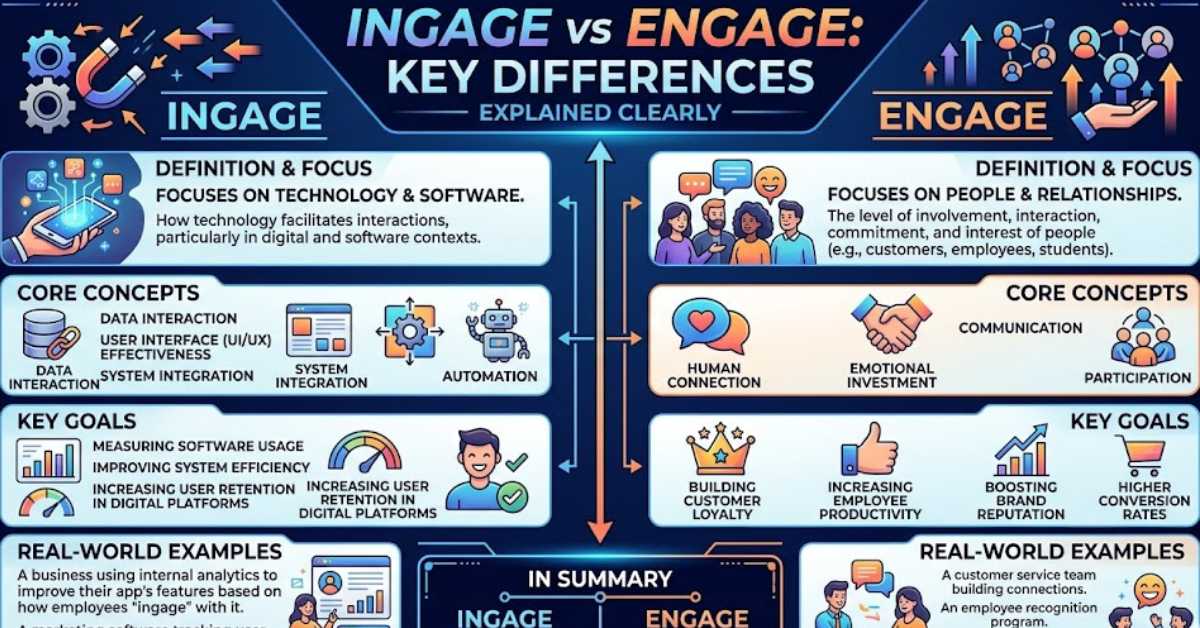
Key Differences Between Ingage vs Engage
To make things even clearer, here’s a simple breakdown:
1. Meaning
- Engage: A verb describing interaction or involvement
- Ingage: A brand name or misspelling
2. Usage
- Engage: Used in everyday language, business, marketing, education
- Ingage: Used mainly in software/product contexts
3. Function
- Engage: Describes behavior (what people do)
- Ingage: Enables behavior (tools that help people engage)
4. Recognition
- Engage: Universally recognized English word
- Ingage: Niche or brand-specific term
Why People Confuse Ingage vs Engage
The Ingage vs Engage confusion usually comes from a few common reasons:
1. Pronunciation similarity
Both words sound almost identical when spoken, especially in casual conversation.
2. Typing errors
Fast typing often leads to missing the “e” at the beginning of “engage.”
3. Brand influence
Because tools like Ingage exist, people assume it might be a different spelling variation.
Real-World Examples of Usage
Engage in Action
- “We need to engage our audience with better storytelling.”
- “The video helped engage users for longer sessions.”
- “Customer engagement increased after the campaign.”
Ingage in Action
- “The sales team uses Ingage to create interactive presentations.”
- “Ingage helps simplify visual storytelling for clients.”
These examples highlight the functional difference in Ingage vs Engage.
When Should You Use Ingage or Engage?
Here’s a simple rule:
Use “Engage” when:
- Writing emails, articles, or reports
- Talking about interaction or participation
- Discussing marketing performance
Use “Ingage” when:
- Referring to the specific presentation software
- Mentioning the brand or platform directly
If you’re unsure, “engage” is almost always the correct choice.
Practical Tips to Avoid Confusion
If you often mix up Ingage vs Engage, these tips can help:
- Double-check spelling before publishing content
- Use grammar tools or spell checkers
- Remember: “engage” = action, “Ingage” = brand
- When in doubt, search the term in context
Key Takeaways
- “Engage” is a standard English verb used in communication and marketing
- “Ingage” is either a brand name or a common misspelling
- The two are not interchangeable in professional writing
- Understanding Ingage vs Engage improves clarity in content and communication
FAQ: Ingage vs Engage
1. What is the difference between Ingage vs Engage?
“Engage” is a real English word meaning to interact or involve. “Ingage” is usually a brand name or spelling variation, not a standard term.
2. Is Ingage a correct spelling of engage?
No, “ingage” is generally considered incorrect in standard English. The correct spelling is “engage.”
3. What is Ingage used for?
Ingage is a digital presentation tool used for creating interactive sales and marketing content.
4. Why do people search Ingage vs Engage?
People often get confused due to similar pronunciation and typing mistakes, leading to mixed usage online.
5. Can I use Ingage instead of engage in writing?
No, in professional or academic writing, you should always use “engage” unless referring to the specific Ingage platform.
6. Is engage only used in marketing?
No, “engage” is used in many fields including education, business, relationships, and everyday communication.
Conclusion
The confusion around Ingage vs Engage is understandable, but once broken down, the difference is quite simple. “Engage” is a widely used English verb describing interaction, while “Ingage” is typically a brand name or common misspelling.
Knowing when and how to use each term helps improve clarity in writing, especially in marketing and professional communication. If your goal is precision, stick with “engage”—and only use “Ingage” when referring to the specific platform.
Understanding this small but important distinction can make your communication sharper, more professional, and easier to understand.
Leave a Reply