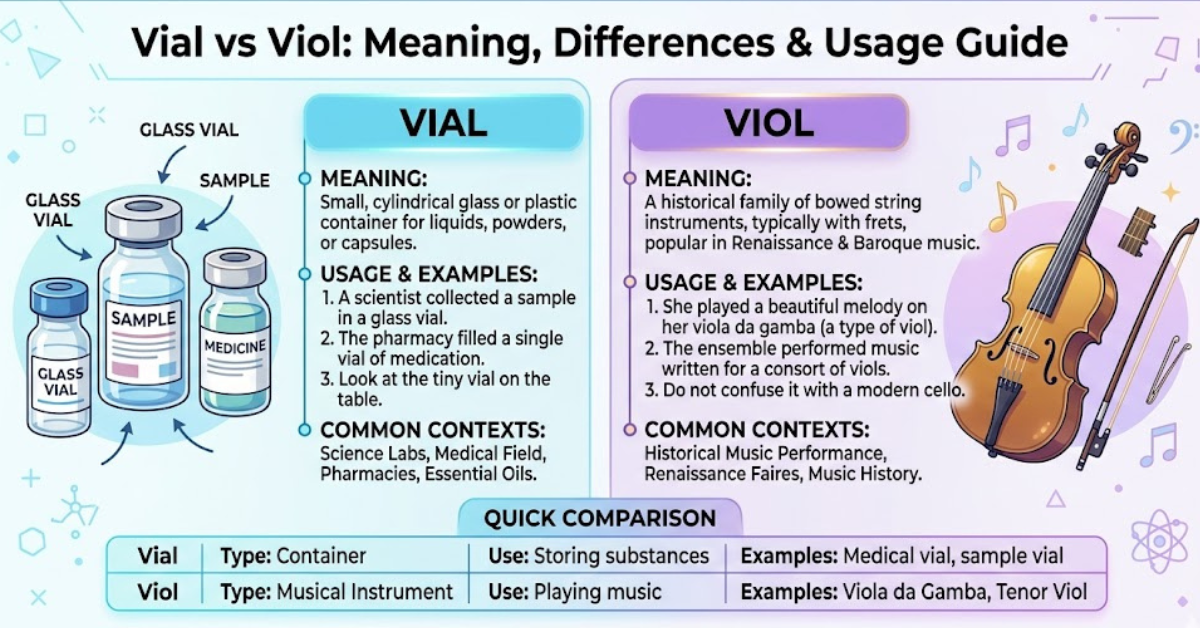
Ever typed vial vs viol and paused for a second wondering if they mean the same thing? You’re not alone. These two words look almost identical, but they belong to completely different worlds—one is medical, the other is musical.
In this guide, we’ll break down vial vs viol, explain their meanings, show real examples, and help you never confuse them again.
What is a Vial?
A vial is a small container, usually made of glass or plastic, used to store liquids, powders, or medicines.
You’ll commonly see vials in:
- Hospitals and clinics
- Laboratories
- Pharmacies
- Vaccination centers
Common uses of a vial
A vial is designed to safely hold sensitive substances such as:
- Vaccines
- Injectable medications
- Chemical samples
- Essential oils or perfumes
In simple terms, a vial is all about storage and protection.
Example sentence:
- The nurse carefully opened the vial to draw the vaccine.
What is a Viol?
A viol is a musical instrument from the string family, popular during the Renaissance and Baroque periods.
It looks similar to a violin but has a softer, deeper sound.
Key facts about a viol:
- It has frets on the fingerboard
- Played with a bow
- Comes in different sizes (treble, tenor, bass viol)
- Used mainly in early classical music
Example sentence:
- The musician performed a haunting melody on the bass viol.
So while a vial is scientific, a viol is artistic.
Vial vs Viol: Key Differences Explained
The confusion between vial vs viol usually comes from spelling, but their meanings are completely unrelated.
Here’s a quick comparison:
| Feature | Vial | Viol |
| Category | Medical / Scientific | Musical Instrument |
| Function | Stores liquids or medicine | Produces musical sound |
| Material | Glass or plastic | Wood and strings |
| Usage today | Very common | Mostly historical/classical |
Why Do People Confuse Vial vs Viol?
The confusion happens mainly because:
- The spelling is nearly identical
- Both are short, single-syllable words
- Auto-correct doesn’t always help
- They appear in different contexts rarely together
A simple trick:
- Vial = Vaccine / medicine container
- Viol = Violin-like instrument
Examples of Vial vs Viol in Sentences
Vial examples:
- The lab technician labeled each vial carefully.
- A single vial contained enough serum for testing.
Viol examples:
- She studied early music and mastered the viol.
- The sound of the viol filled the hall with warmth.
Vial vs Viol in Everyday Language
In modern usage, you are far more likely to encounter vial than viol.
- Doctors, nurses, and pharmacists use vial daily
- Viol appears mostly in historical music studies or orchestras specializing in early music
So if you’re reading science or health content, it’s almost always vial. If it’s about classical music history, it might be viol.
FAQs: Vial vs Viol
1. What is the main difference between vial and viol?
A vial is a container for liquids, while a viol is a string musical instrument.
2. Is viol still used today?
Yes, but mostly in classical or early music performances, not in modern mainstream music.
3. Can vial and viol be used interchangeably?
No, they have completely different meanings and contexts.
4. How do you remember vial vs viol easily?
Think: vial = vaccine container, viol = violin family instrument.
5. Which word is more common?
“Vial” is far more commonly used in everyday language.
Conclusion
The confusion between vial vs viol is understandable, but once you know their meanings, it becomes easy to separate them. A vial belongs to science and medicine, while a viol belongs to the world of classical music.
If you’re writing, studying, or just trying to improve your vocabulary, remembering this simple distinction will save you from common spelling mix-ups.
Want to sharpen your English further? Exploring similar word pairs can make a big difference in both writing clarity and confidence.
Leave a Reply