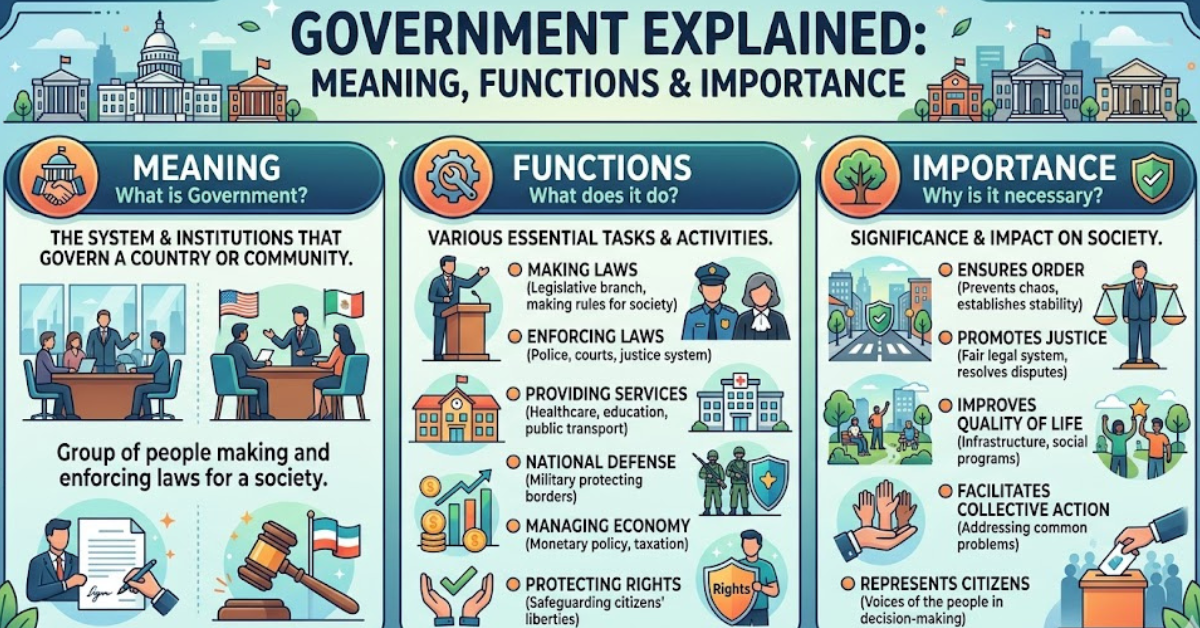
The word government or goverment (a common spelling variation) is something we hear every day, but not everyone fully understands what it really means. In simple terms, a government is the system or group of people responsible for running a country, making laws, and ensuring order in society.
From schools and hospitals to roads and national security, almost everything around us is influenced by how the government works. In this article, we’ll break down what government is, how it functions, its types, and why it matters so much in everyday life.
What Is Government?
A government is an organized system that has the authority to govern a state or community. It creates and enforces laws, collects taxes, provides public services, and maintains peace.
Even though people sometimes misspell it as “goverment,” the meaning remains the same: it refers to the central authority that manages a country’s affairs.
Key responsibilities of a government include:
- Making and enforcing laws
- Protecting citizens and borders
- Providing public services
- Managing the economy
- Ensuring justice and equality
Without a government, society would lack structure, leading to chaos and disorder.
Why Government Is Important in Society
The importance of government cannot be overstated. It plays a central role in maintaining balance and stability in a country.
1. Law and Order
Governments establish laws that help control behavior and ensure safety. Police and legal systems help enforce these rules.
2. Public Services
Governments provide essential services such as:
- Education
- Healthcare
- Transportation
- Clean water supply
3. Economic Stability
A government manages inflation, employment, taxation, and trade policies to keep the economy stable.
4. National Security
Defense forces like the army and police are controlled by the government to protect citizens from internal and external threats.
5. Social Welfare
Many governments run programs to support low-income families, elderly citizens, and unemployed individuals.
Types of Government Systems
Different countries follow different government systems, depending on their history, culture, and political structure.
1. Democracy
In a democracy, people choose their leaders through voting. It is one of the most common systems in the world.
Key features:
- Free elections
- Equal rights
- Rule of law
2. Monarchy
A monarchy is ruled by a king or queen. It can be:
- Absolute monarchy (complete power)
- Constitutional monarchy (limited power with laws)
3. Dictatorship
In a dictatorship, one person or a small group holds full control, often without public elections.
4. Republic
A republic is a system where the country is considered a “public matter,” and leaders are elected by citizens.
5. Federal System
Power is divided between central and regional governments (like in the USA or Pakistan).
Structure of Government
Most governments are divided into three main branches to ensure balance and fairness:
1. Executive Branch
This includes the president, prime minister, and cabinet. They implement laws and run the country.
2. Legislative Branch
This branch makes laws. It usually includes parliament or congress.
3. Judicial Branch
Courts and judges fall under this branch. They interpret laws and ensure justice.
This separation prevents any single group from gaining too much power.
How Government Affects Daily Life
You might not always notice it, but the government or goverment system influences your everyday routine.
Examples:
- The price of fuel and electricity
- School curriculum and education system
- Road construction and traffic rules
- Healthcare facilities in hospitals
- Job opportunities and taxes
In short, government decisions shape the quality of life in a country.
Challenges Governments Face
Running a country is not easy. Governments often deal with complex challenges such as:
- Unemployment and poverty
- Corruption and mismanagement
- Inflation and economic crises
- Political instability
- Climate change and disasters
Good governance requires transparency, accountability, and strong leadership.
Characteristics of a Good Government
A successful government is not just about power—it’s about responsibility.
A good government is:
- Transparent in its actions
- Accountable to the people
- Fair and unbiased
- Efficient in service delivery
- Focused on public welfare
When these qualities are present, citizens tend to trust the system more.
Importance of Citizen Participation
A government works best when citizens are actively involved. People can participate by:
- Voting in elections
- Following laws
- Paying taxes honestly
- Staying informed about policies
- Raising their voices for justice
Democracy, in particular, depends heavily on active public participation.
FAQs About Government
1. What is the simple definition of government?
A government is the system that runs a country, makes laws, and provides services for citizens.
2. Why do we need a government?
We need a government to maintain law and order, protect citizens, and manage public resources.
3. What are the main types of government?
The main types include democracy, monarchy, dictatorship, republic, and federal systems.
4. What is the difference between government and goverment?
“Government” is the correct spelling, while “goverment” is a common misspelling with the same meaning.
5. How does government affect daily life?
It influences education, healthcare, transportation, taxes, and overall living standards.
Conclusion
Understanding the concept of government or goverment helps us realize how deeply it shapes society. From maintaining law and order to providing essential services, the government plays a crucial role in every aspect of life.
A strong and responsible government ensures stability, growth, and fairness for all citizens. As individuals, staying informed and participating in civic activities helps build a better and more transparent system.
If you’re interested in learning more, explore topics like political systems, civic rights, and public administration to deepen your understanding of how governments truly work.
Leave a Reply