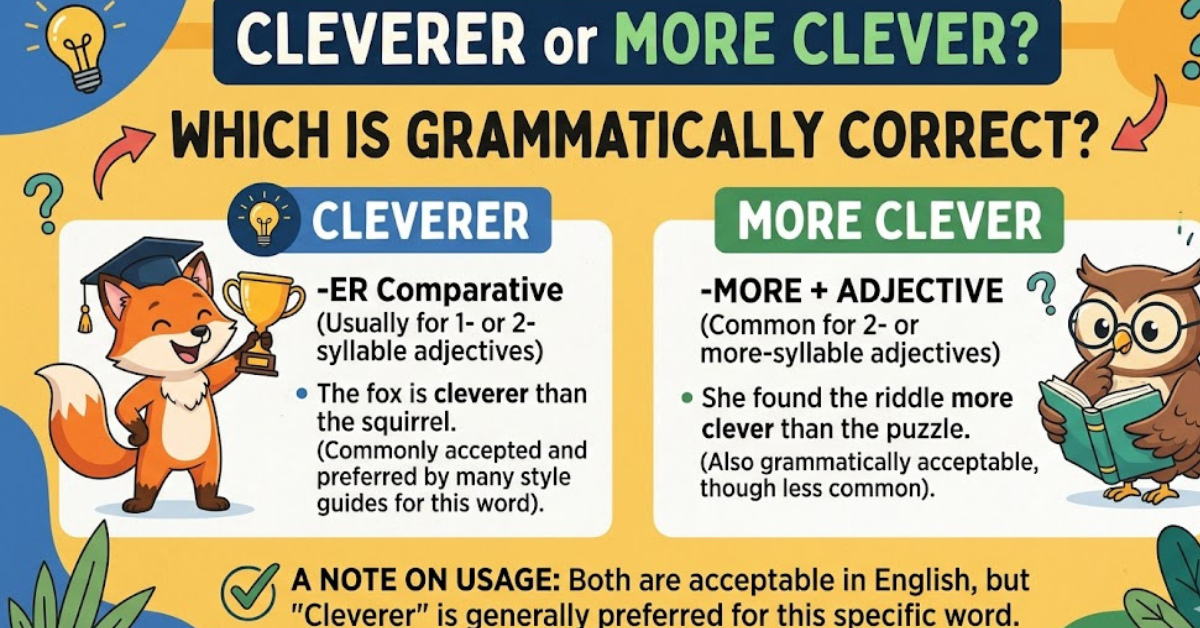
Have you ever paused while writing and wondered whether cleverer or more clever is the correct choice? You’re not alone. English is full of words that can be compared in more than one way, and clever is one of them.
The good news is that both cleverer and more clever are grammatically correct. However, native speakers often prefer one form over the other depending on context, style, and regional usage. In this guide, we’ll explore the difference between cleverer or more clever, explain the grammar behind comparative adjectives, and show you how to use each option naturally.
Understanding the Comparison of “Clever”
The adjective clever describes someone who is intelligent, quick-thinking, or inventive. When comparing two people or things, English uses a comparative form.
For example:
- Sarah is cleverer than her brother.
- Sarah is more clever than her brother.
Both sentences are correct and communicate the same meaning.
What Is a Comparative Adjective?
Comparative adjectives are used to compare two nouns.
Common examples include:
| Base Adjective | Comparative |
| Tall | Taller |
| Fast | Faster |
| Smart | Smarter |
| Clever | Cleverer / More Clever |
Most one-syllable adjectives add -er, while longer adjectives typically use more. Since clever has two syllables, it falls into a category where either form is acceptable.
Cleverer or More Clever: Which Is Correct?
The simple answer is that both are correct.
According to major English grammar authorities and dictionaries, clever can form its comparative in two ways:
- Cleverer
- More clever
Examples:
- Emma is cleverer than most students in her class.
- Emma is more clever than most students in her class.
Neither sentence is grammatically wrong.
Why Do Both Forms Exist?
English grammar evolved from several language influences, which is why some adjectives allow multiple comparative forms.
Words with two syllables ending in:
- -y (happy → happier)
- -ow (narrow → narrower)
- -er (clever → cleverer)
often accept both structures.
This flexibility gives writers and speakers stylistic choices.
When to Use “Cleverer”
Traditional Comparative Form
Many grammar guides consider cleverer the more traditional comparative.
Examples:
- She became cleverer as she gained experience.
- The younger child proved cleverer than expected.
- This solution is cleverer than the previous one.
Advantages of Using Cleverer
- Shorter and more concise
- Common in formal writing
- Fits standard comparative adjective patterns
- Frequently used in British English
Because it is compact, many editors prefer cleverer when space and clarity matter.
When to Use “More Clever”
A Natural Alternative
Many native speakers, particularly in conversational English, use more clever because it can sound smoother in some contexts.
Examples:
- That marketing strategy is more clever than it appears.
- The new design feels more clever and practical.
- His response was more clever than funny.
Advantages of Using More Clever
- Can sound less awkward to some speakers
- Often preferred in modern American English
- Useful when emphasizing the quality of cleverness
In certain sentences, more clever may simply flow better.
Cleverer vs More Clever: Which Sounds Better?
There is no universal rule because preference often depends on style and audience.
Cleverer Often Sounds Better When:
- Writing academic content
- Following traditional grammar patterns
- Keeping sentences concise
Example:
- The revised proposal is cleverer than the original.
More Clever Often Sounds Better When:
- Writing conversational content
- Emphasizing comparison
- Avoiding repetitive “-er” sounds
Example:
- The solution turned out to be more clever than anyone expected.
Regional Differences in Usage
British English
British speakers generally use cleverer more frequently.
Examples:
- She’s much cleverer than she looks.
- That was the cleverer choice.
American English
American speakers often use both forms but may lean toward more clever in casual speech.
Examples:
- That’s a more clever approach.
- He seems more clever than his competitors.
The difference isn’t strict, but regional tendencies do exist.
Common Grammar Mistakes to Avoid
When discussing cleverer or more clever, some mistakes appear frequently.
1. Using Double Comparatives
Incorrect:
- She is more cleverer than her sister.
Correct:
- She is cleverer than her sister.
- She is more clever than her sister.
Never combine more with -er.
2. Comparing More Than Two Items Incorrectly
If comparing three or more things, use the superlative form.
Examples:
- Clever → Cleverest
- Clever → Most Clever
Correct:
- She is the cleverest student in the class.
- She is the most clever student in the class.
Examples of Cleverer and More Clever in Sentences
Here are practical examples showing both forms.
Using Cleverer
- The second plan was cleverer than the first.
- Jake became cleverer through practice.
- Her explanation was cleverer than expected.
Using More Clever
- The advertising campaign was more clever than effective.
- Their solution was more clever than expensive.
- The plot twist became more clever upon a second viewing.
What Do Style Guides Recommend?
Most modern style guides acknowledge that both forms are acceptable.
However:
- Formal writing often favors cleverer.
- Casual writing may favor more clever.
- Consistency matters more than the specific choice.
If you’re writing an article, essay, or professional document, choose one style and use it consistently throughout the piece.
Cleverer or More Clever: Quick Rule Summary
Remember these simple guidelines:
- Both cleverer and more clever are correct.
- Cleverer is traditionally preferred.
- More clever is increasingly common in everyday speech.
- Never write more cleverer.
- Match your choice to your audience and tone.
FAQs
Is cleverer a real word?
Yes. Cleverer is a standard English comparative adjective recognized by dictionaries and grammar authorities.
Which is more correct: cleverer or more clever?
Neither is more correct. Both forms are grammatically acceptable.
Do native English speakers say cleverer?
Yes. Many native speakers, especially in the UK, regularly use cleverer in speech and writing.
Is more clever wrong?
No. More clever is grammatically correct and widely used.
What is the superlative form of clever?
The superlative forms are:
- Cleverest
- Most clever
Both are accepted, though cleverest is more common.
Can I use cleverer in formal writing?
Absolutely. In fact, many editors and style guides consider cleverer perfectly appropriate for formal writing.
Conclusion
When deciding between cleverer or more clever, the answer is refreshingly simple: both are correct. English allows two comparative forms for the adjective clever, giving writers and speakers flexibility in how they express comparisons.
If you’re aiming for a traditional and concise style, cleverer is often the best choice. If you’re writing conversationally or prefer a slightly more modern rhythm, more clever works just as well. The key is to remain consistent and avoid incorrect forms like more cleverer.
Leave a Reply