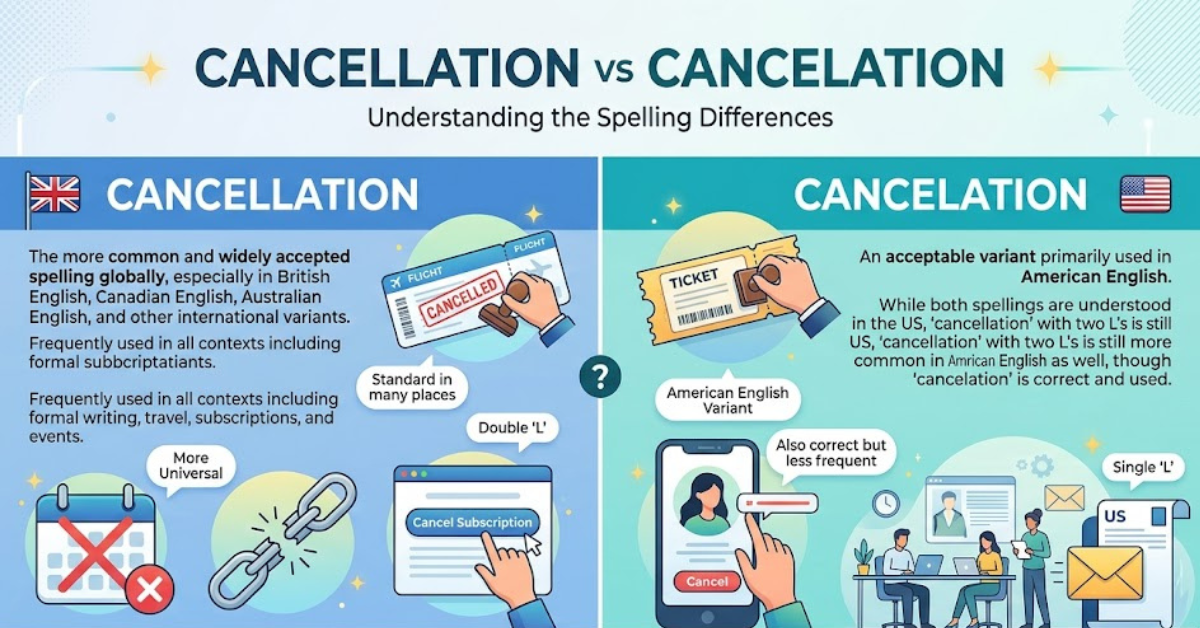
Have you ever typed cancelation in an email only to see a red spell-check line appear underneath it? You’re not alone. The debate around cancellation vs cancelation confuses writers, students, business professionals, and even native English speakers.
At first glance, both words seem correct because they come from the verb cancel. But only one spelling is widely accepted in standard English. Understanding the difference can improve your writing, help you avoid grammar mistakes, and make your communication look more polished and professional.
In this guide, we’ll break down the meaning of cancellation vs cancelation, explain which spelling is correct, explore regional differences, and provide examples you can actually use in everyday writing.
What Does “Cancellation” Mean?
The word cancellation is a noun that refers to the act of canceling something.
It can describe:
- Ending an event
- Stopping a subscription
- Voiding an agreement
- Calling off a trip, meeting, or reservation
Examples of “Cancellation” in Sentences
- The airline announced the cancellation of all flights due to weather.
- We received a cancellation notice from the hotel.
- Ticket cancellation fees may apply.
In modern English, cancellation is the standard and preferred spelling.
Cancellation vs Cancelation: What’s the Difference?
The main difference between cancellation vs cancelation comes down to spelling preference and accepted usage.
| Word | Is It Correct? | Common Usage |
| Cancellation | Yes | Standard spelling worldwide |
| Cancelation | Rarely | Considered a variant spelling |
The Correct Spelling
Cancellation with a double “L” is the most accepted spelling in:
- American English
- British English
- Canadian English
- Australian English
Is “Cancelation” Wrong?
Not completely. Cancelation with one “L” exists as an alternative spelling in some dictionaries, especially older American references. However, it’s considered uncommon and less professional today.
Most grammar experts, style guides, and spell-check tools recommend using cancellation instead.
Why Does “Cancellation” Have Two L’s?
This confusion happens because English spelling rules can be inconsistent.
The verb is spelled:
- Cancel (one “L” in American English)
- Cancel (same in British English)
But when adding the suffix “-ation,” the word becomes:
- Cancellation
The Grammar Rule Behind It
In British English, verbs often double the final “L” before adding suffixes:
- Travel → travelling
- Signal → signalling
- Cancel → cancellation
American English sometimes simplifies spellings, but cancellation remains the dominant form even in the United States.
Is “Cancelation” Ever Acceptable?
Technically, yes — but it’s rarely recommended.
Some older American dictionaries list cancelation as a secondary variant. You may occasionally see it in:
- Old documents
- Historical texts
- Informal online writing
Still, professional writers almost always choose cancellation.
When You Should Avoid “Cancelation”
Avoid using cancelation in:
- Academic writing
- Business emails
- Websites and blogs
- Professional documents
Using the standard spelling improves credibility and avoids confusion.
Cancellation vs Cancelation in American and British English
One common misconception is that one spelling is British while the other is American. That’s not true.
American English
Preferred spelling:
- Cancellation
British English
Preferred spelling:
- Cancellation
Both forms of English overwhelmingly favor the double-L version.
Common Examples of “Cancellation” in Everyday Life
You probably see the word more often than you realize. Here are common contexts where cancellation appears.
Travel and Airlines
- Flight cancellation
- Hotel cancellation
- Trip cancellation insurance
Business and Services
- Subscription cancellation
- Membership cancellation
- Order cancellation
Entertainment
- Event cancellation
- Concert cancellation
- TV show cancellation
Legal and Financial Contexts
- Policy cancellation
- Contract cancellation
- Check cancellation
Why Correct Spelling Matters for SEO and Professional Writing
Choosing the correct spelling isn’t just about grammar. It also affects:
1. User Trust
Readers are more likely to trust content without spelling inconsistencies.
2. Professional Communication
Correct spelling creates a polished impression in:
- Emails
- Applications
- Reports
- Marketing content
Commonly Confused Word Variations
Here are related spellings people often mix up.
| Incorrect or Rare Form | Preferred Form |
| Cancelation | Cancellation |
| Cancelling | Cancelling (UK), Canceling (US) |
| Cancelled | Cancelled (UK), Canceled (US) |
Interestingly, American English accepts:
- Canceled
- Canceling
But still strongly prefers:
- Cancellation
That inconsistency is one reason the confusion exists.
Tips to Remember the Correct Spelling
If you struggle to remember whether it’s cancellation or cancelation, these tricks can help.
Easy Memory Trick
Think of it this way:
The “L” gets doubled in “cancellation” just like many other nouns ending in “-ation.”
Examples:
- Translate → translation
- Celebrate → celebration
- Cancel → cancellation
Use Spell Check Carefully
Many spell-check tools automatically flag cancelation as incorrect or uncommon.
Cancellation vs Cancelation: Quick Summary
Here’s a simple breakdown.
Use “Cancellation” When:
- Writing professionally
- Creating website content
- Sending emails
- Publishing articles
- Completing academic work
Avoid “Cancelation” Because:
- It’s rare
- It looks incorrect to many readers
- It may reduce credibility
FAQs About Cancellation vs Cancelation
Is cancellation spelled with one L or two?
The correct and most widely accepted spelling is cancellation with two L’s.
Is cancelation a real word?
Yes, cancelation exists as a rare alternative spelling, mainly in older American English. However, it’s uncommon and generally avoided today.
Which spelling is correct in American English?
American English strongly prefers cancellation.
Why is cancellation spelled differently from canceled?
American English simplifies some verb forms like:
- canceled
- canceling
But the noun form still remains:
- cancellation
Should I use cancelation in professional writing?
No. Use cancellation for professional, academic, and online writing.
Does Google recognize both spellings?
Yes, but cancellation is far more common and favored in search results.
Conclusion
The debate around cancellation vs cancelation is simpler than it first appears. While both spellings technically exist, cancellation is the clear standard in modern English. It’s the preferred spelling in American and British English, widely accepted in professional writing, and recognized more effectively by search engines.
If you want your writing to appear polished, credible, and grammatically correct, stick with cancellation every time.
Leave a Reply