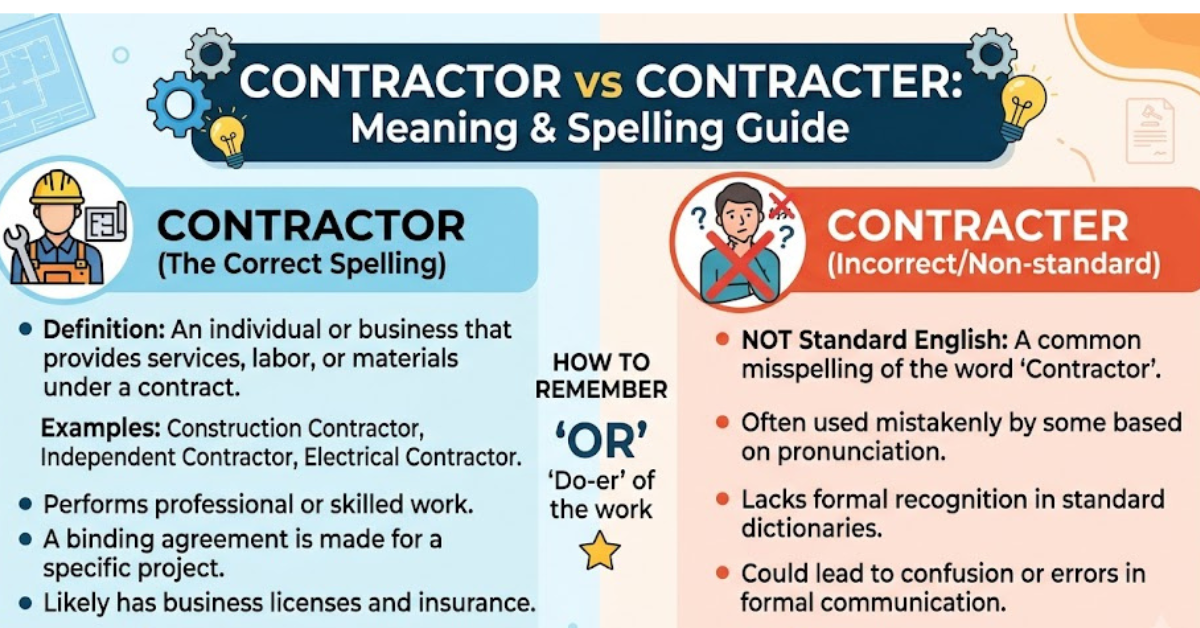
Have you ever paused while typing and wondered whether it’s “contractor” or “contracter”? You’re not alone—this small spelling confusion shows up more often than you’d expect in job posts, legal documents, and online searches.
The term Contractor vs Contracter is a common point of confusion, especially for people working in construction, freelancing, or business contracts. In this article, we’ll clear up the correct spelling, explain the meaning, and show how the word is used in real-world situations.
By the end, you’ll confidently understand the difference, avoid common mistakes, and use the term correctly in professional and everyday writing.
What Does a Contractor Mean?
A contractor is a person or company hired to perform specific work under a contract. This can apply across many industries, from construction to IT services.
Common types of contractors include:
- Construction contractors – build houses, roads, or infrastructure
- Freelance contractors – writers, designers, developers
- Government contractors – provide services to public sector projects
- Subcontractors – hired by primary contractors for specialized tasks
In simple terms, a contractor is someone who agrees to complete work for payment under agreed terms.
This is where understanding Contractor vs Contracter becomes important, especially in professional communication.
Is “Contracter” Correct or a Mistake?
The short answer: “Contracter” is incorrect in standard English.
The correct spelling is contractor, derived from the verb “contract” plus the suffix “-or”, which indicates a person who performs an action.
Why the confusion happens:
- Mishearing the word in spoken English
- Typing errors (especially on mobile keyboards)
- Influence of similar-looking words like “builder” or “designer”
- Non-native English spelling variations
So when comparing Contractor vs Contracter, only one is grammatically and professionally accepted.
Contractor vs Contracter: Key Differences Explained
Understanding Contractor vs Contracter is mainly about spelling accuracy rather than meaning differences.
1. Spelling
- Correct: Contractor
- Incorrect: Contracter
2. Usage in professional settings
- “Contractor” appears in legal contracts, job titles, and business documents
- “Contracter” is considered a spelling error and is not used officially
3. Search engine and SEO impact
Using the wrong spelling can affect:
- Job listings visibility
- Website rankings
- Professional credibility
Even small spelling mistakes can change how content is interpreted online.
Where the Term “Contractor” Is Commonly Used
The word “contractor” is widely used across industries, making it essential to understand the correct form when discussing Contractor vs Contracter.
Construction Industry
Contractors manage building projects, coordinate workers, and ensure completion within budget and time.
Freelancing & Gig Economy
Writers, developers, and designers often work as independent contractors.
Government & Corporate Projects
Large organizations hire contractors for IT systems, maintenance, and consultancy services.
Real-world example:
A company may say:
“We hired a contractor to redesign our website.”
Why Correct Spelling Matters in Professional Writing
Spelling isn’t just about grammar—it affects clarity, trust, and search visibility.
When comparing Contractor vs Contracter, the correct version plays a crucial role in:
1. Professional credibility
Incorrect spelling in resumes, contracts, or proposals can reduce trust.
2. Legal documentation
Contracts require precise language; errors can cause confusion or disputes.
3. Communication clarity
Clear writing ensures no misunderstanding between clients and service providers.
Practical Tips to Avoid the “Contracter” Mistake
Here are simple ways to always get it right:
- Remember: “contractor” ends with -or, like “actor” or “doctor”
- Use spell-check tools when writing professionally
- Read sentences aloud to catch unusual spellings
- Save commonly used job titles in templates
These small habits eliminate confusion in Contractor vs Contracter usage.
Key Takeaways
- “Contractor” is the correct and accepted spelling
- “Contracter” is a common but incorrect variation
- The word is widely used in construction, freelancing, and business
- Correct spelling improves professionalism and SEO performance
- Understanding Contractor vs Contracter helps avoid writing errors
FAQs
1. What is the correct spelling: contractor or contracter?
The correct spelling is contractor. “Contracter” is a common spelling mistake and not accepted in formal English.
2. What does a contractor do?
A contractor performs work under a contract, often in construction, freelancing, or business services.
3. Why do people write contracter instead of contractor?
It usually happens due to typing errors or confusion with similar English word endings.
4. Is “contracter” used in any country or industry?
No, “contracter” is not a standard or recognized term in professional or legal usage.
5. What is the difference in Contractor vs Contracter?
There is no difference in meaning—only spelling. “Contractor” is correct, while “contracter” is incorrect.
Conclusion
Understanding the difference in Contractor vs Contracter is simple but important for clear communication and professional writing. While the meaning stays the same, only “contractor” is grammatically correct and widely accepted.
Whether you’re writing a job post, a contract, or SEO content, using the right spelling helps you look credible and ensures better visibility online. Apply these insights, and you’ll avoid one of the most common English spelling mistakes with ease.
Leave a Reply