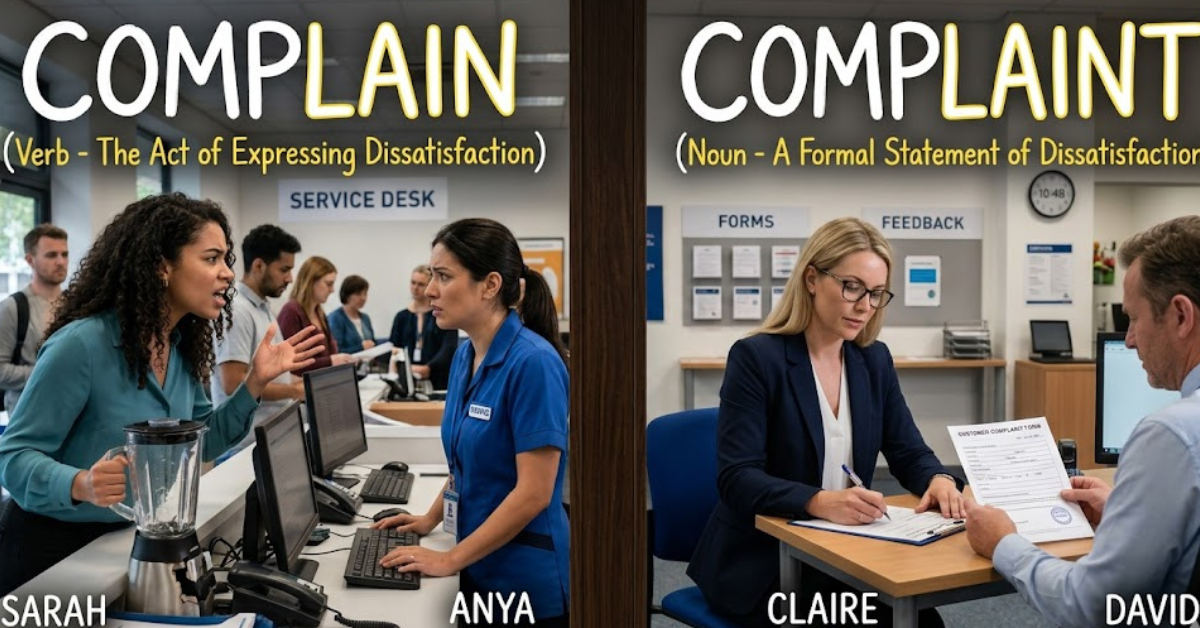
Ever paused mid-sentence wondering whether to use complaint vs complain? You’re not alone. Even fluent English speakers mix these two words because they look similar but function very differently in grammar and meaning.
In simple terms, “complain” is a verb, while “complaint” is a noun. But understanding when and how to use them correctly can instantly improve your writing, speaking, and overall communication clarity.
Let’s break it down in a simple, practical way so you never confuse them again.
What Does “Complain” Mean?
The word complain is a verb. It refers to the action of expressing dissatisfaction, annoyance, or discomfort about something.
Definition of Complain
To say that something is wrong or not satisfactory.
Examples of “Complain” in Sentences:
- She always complains about the weather.
- Don’t complain if you didn’t try your best.
- He complained about the poor service at the restaurant.
Key Grammar Tip:
- Base form: complain
- Past tense: complained
- Present participle: complaining
So whenever you’re talking about an action, you use complain.
What Does “Complaint” Mean?
The word complaint is a noun. It refers to the expression of dissatisfaction itself or a formal report about a problem.
Definition of Complaint
A statement that something is wrong or not satisfactory, or an official report of dissatisfaction.
Examples of “Complaint” in Sentences:
- The customer filed a complaint against the company.
- We received several complaints about the noise.
- Her main complaint was about delayed delivery.
Key Grammar Tip:
Use complaint when you are referring to the thing being expressed, not the action.
Complaint vs Complain: The Core Difference
Understanding complaint vs complain becomes easy when you remember this simple rule:
| Word | Type | Meaning | Example |
| Complain | Verb | The action of expressing issue | I complain daily |
| Complaint | Noun | The issue or expression itself | I filed a complaint |
Quick Memory Trick:
- Complain = Action (verb)
- Complaint = Thing (noun)
Common Mistakes People Make
Even though the rule is simple, mistakes still happen in everyday English.
1. Using “complain” instead of “complaint”
I have a complain about the service.
I have a complaint about the service.
2. Using “complaint” instead of “complain”
She always complaint about food.
She always complains about food.
Why this happens:
Both words sound similar and share the same root, but grammar function changes everything.
Real-Life Usage Examples
Let’s see how complaint vs complain works in real situations:
Customer Service Context:
- Customers often complain when they face delays.
- The company recorded over 200 complaints last month.
Workplace Context:
- Employees may complain about workload stress.
- HR handles official complaints professionally.
Daily Life Context:
- Don’t complain about small issues.
- She has no complaint about her job.
Synonyms to Improve Your Vocabulary
Using related words can make your English more natural.
For “Complain” (Verb):
- Protest
- Grumble
- Object
- Whine
- Criticize
For “Complaint” (Noun):
- Grievance
- Issue
- Concern
- Objection
- Report
Why Understanding “Complaint vs Complain” Matters
Using these words correctly improves:
- Grammar accuracy
- Professional communication
- Writing clarity
- Confidence in speaking English
In formal settings like emails, interviews, or business communication, mixing them up can make your message unclear or unprofessional.
Easy Tips to Remember the Difference
Here are simple tricks to lock it in your memory:
- If you can replace it with “doing,” use complain
- He is doing the action → He is complaining
- If it is a “thing” or “report,” use complaint
- The complaint is filed → It’s a noun
- Think of:
- Complain = Action
- Complaint = Paper/file/report
FAQs: Complaint vs Complain
1. What is the main difference between complaint and complain?
Complain is a verb (action), while complaint is a noun (thing or statement).
2. Can I say “I have a complain”?
No, it is incorrect. The correct form is “I have a complaint.
3. Is complain always negative?
Mostly yes, it expresses dissatisfaction, but it can also be used casually in everyday speech.
4. What is the past tense of complain?
The past tense is complained.
5. Is complaint formal or informal?
Complaint is often used in formal contexts like customer service, legal matters, and official reports.
Conclusion: Mastering Complaint vs Complain
The confusion between complaint vs complain is common, but once you understand the basic grammar rule, it becomes second nature. Remember this simple breakdown:
- Complain = action (verb)
- Complaint = thing (noun)
Using them correctly will instantly improve your English accuracy, especially in writing and professional communication.
If you want to strengthen your grammar further, explore more common word pairs and practice them in daily sentences. Small improvements like this make a big difference over time.
Leave a Reply