Have you ever paused while typing a word like “offend” and wondered if it could also be spelled “affend”? You’re not alone. The confusion around Affend vs Offend is more common than you might think, especially for English learners and even native speakers who rely heavily on pronunciation rather than spelling.
The keyword Affend vs Offend highlights a frequent spelling mix-up in English vocabulary. In this article, you’ll learn which spelling is correct, why the mistake happens, what “offend” actually means, and how to avoid similar errors in the future. By the end, you’ll have a clear, practical understanding that helps improve both your writing and communication skills.
Affend vs Offend: What’s the Correct Spelling?
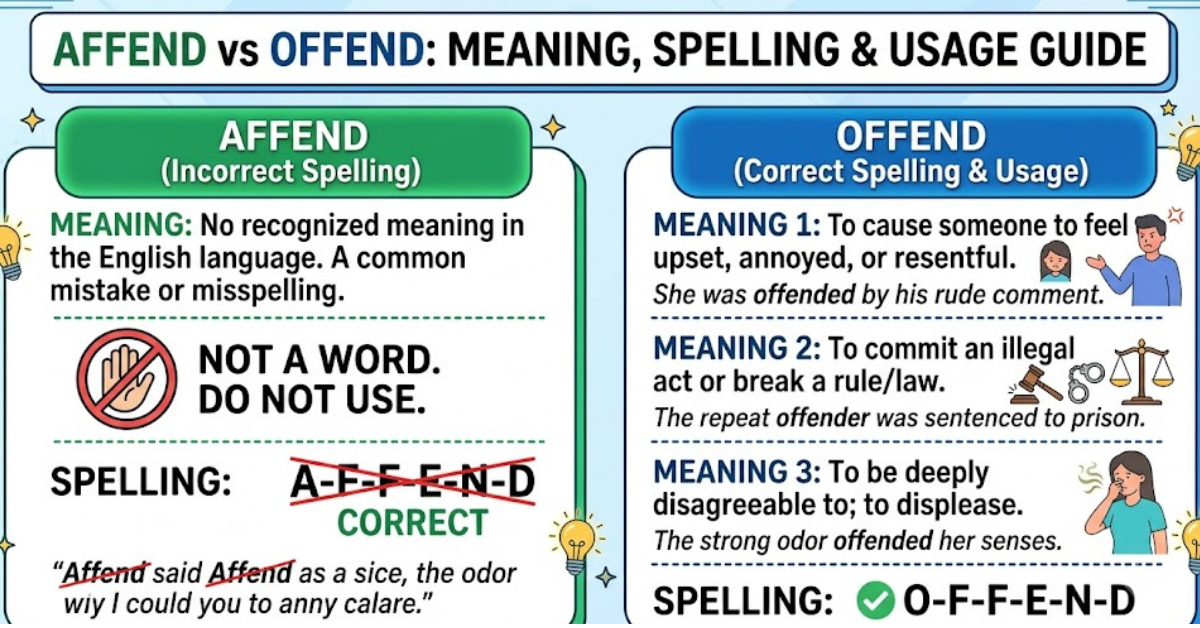
Let’s get this straight from the start: the correct spelling is “offend,” not “affend.”
The phrase Affend vs Offend often appears in search queries because people hear the word and assume a different spelling. However, “affend” is not recognized in standard English dictionaries.
Why only “offend” is correct
- “Offend” comes from Latin offendere, meaning “to strike against” or “to irritate”
- It has been part of English usage for centuries
- “Affend” does not exist in formal or informal English usage
So whenever you come across Affend vs Offend, remember that only “offend” is valid.
Why “Affend” Is a Common Mistake
The confusion behind Affend vs Offend usually comes from how the word sounds when spoken.
Phonetics and pronunciation
When spoken quickly, “offend” can sound like “uh-fend,” leading some people to assume it starts with an “A” sound.
Typing and autocorrect errors
- Fast typing on mobile devices
- Predictive text errors
- Mishearing in conversations
These factors contribute to the spread of the incorrect form “affend.”
Meaning of “Offend” (Definition & Usage)
To fully understand Affend vs Offend, it’s important to know what “offend” actually means.
Definition of offend
“Offend” means to:
- Cause someone to feel upset, insulted, or annoyed
- Violate moral or social rules
- Act in a way that causes displeasure or disrespect
Simple examples
- His rude comment might offend some people.
- I didn’t mean to offend you with my joke.
- Certain topics can easily offend audiences in formal settings.
Real-World Usage Examples
Understanding Affend vs Offend becomes easier when you see “offend” in real contexts:
- Workplace: “Try not to offend clients during negotiations.”
- Social media: “Posts should be respectful to avoid offending followers.”
- Daily conversation: “I hope I didn’t offend you earlier.”
These examples show how widely the word is used in both formal and informal communication.
How to Avoid Spelling Mistakes Like This
If Affend vs Offend has ever confused you, here are some simple ways to avoid similar mistakes:
1. Rely on dictionary verification
Always double-check unfamiliar spellings.
2. Learn word roots
Understanding Latin or Greek origins helps you remember correct forms.
3. Use spelling tools wisely
Grammarly, spellcheck, and autocorrect can catch errors instantly.
4. Practice common tricky words
Words like:
- accommodate
- definitely
- separate
- offend
Key Takeaways
- “Affend” is incorrect; “offend” is the correct spelling
- The confusion in Affend vs Offend comes from pronunciation and typing errors
- “Offend” means to insult, upset, or irritate someone
- Learning word roots and using tools can prevent spelling mistakes
FAQs on Affend vs Offend
1. Is “affend” a real English word?
No, “affend” is not recognized in standard English. Only “offend” is correct.
2. Why do people search Affend vs Offends?
Most people are unsure about spelling due to pronunciation confusion or typing mistakes.
3. What does “offend” mean in simple words?
It means to upset, insult, or annoy someone through words or actions.
4. Can “affend” be used in informal writing?
No, even in informal writing, “affend” is incorrect and should be avoided.
5. How can I remember the correct spelling of offend?
Think of it as “off + end” where something crosses a boundary and causes discomfort.
6. Is Affend vs Offends a common grammar mistake?
Yes, it is a common spelling confusion, especially among new English learners.
Conclusion
The confusion around Affend vs Offend is understandable, but the answer is simple: “offend” is the only correct spelling. “Affend” has no place in standard English, and avoiding it will instantly improve your writing accuracy.
By understanding the meaning, pronunciation, and correct usage of “offend,” you can communicate more clearly and confidently. Keep practicing, stay mindful of common spelling traps, and your English skills will naturally become sharper over time.
Leave a Reply