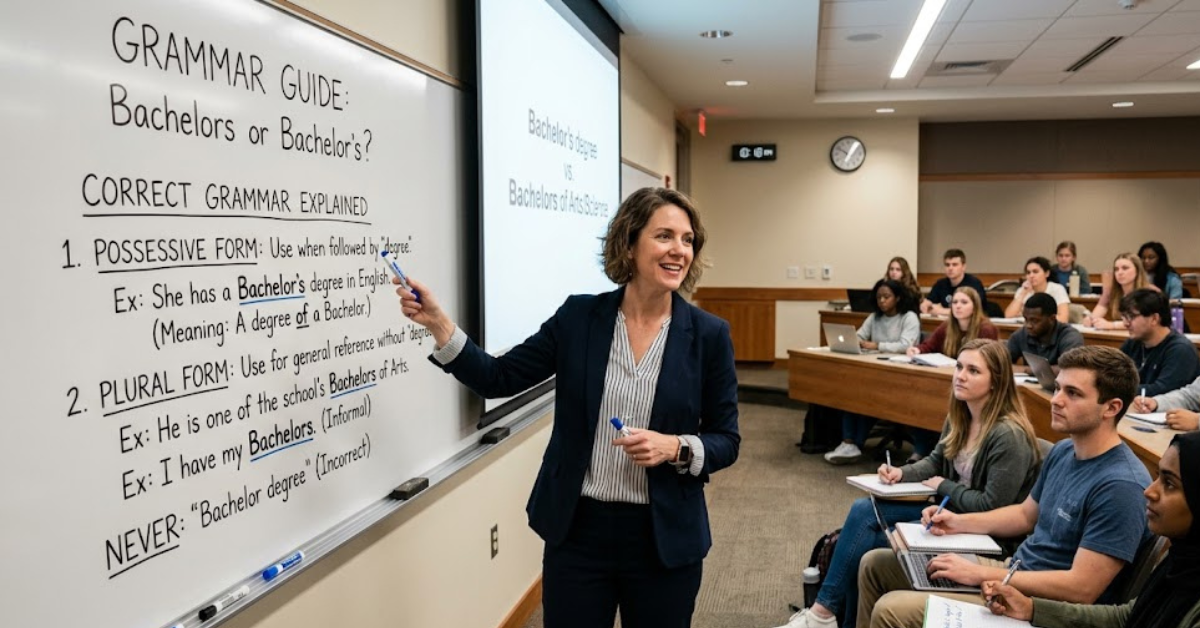
If you’ve ever stopped mid-sentence wondering whether it’s bachelors or bachelor’s, you’re definitely not alone. This small grammatical detail confuses students, job seekers, writers, and even professionals updating their resumes. The difference may seem minor, but using the correct form matters in academic writing, resumes, applications, and professional communication.
In most cases, the correct phrase is “bachelor’s degree” with an apostrophe. However, there are situations where people intentionally shorten the phrase or style it differently. Understanding when and why can help you avoid common grammar mistakes and appear more polished in writing.
This guide breaks down everything you need to know about bachelors or bachelor’s degree usage, grammar rules, resume formatting, and common examples in plain English.
What Is the Correct Form: Bachelors or Bachelor’s?
The grammatically correct term is bachelor’s degree.
The apostrophe is important because the degree originally meant a degree “of a bachelor.” In English grammar, possessive forms often use apostrophes to show ownership or association.
Examples:
- Correct: Bachelor’s degree in Psychology
- Correct: Bachelor of Science
- Incorrect: Bachelors degree
- Incorrect: Bachelor degree
So if you’re asking, is it bachelors or bachelor’s, the answer is usually bachelor’s.
Why Does “Bachelor’s Degree” Have an Apostrophe?
The apostrophe exists because “bachelor’s” is possessive. It refers to a degree belonging to or associated with a bachelor.
This follows traditional English grammar patterns similar to:
- Master’s degree
- Associate’s degree
Even though modern usage has evolved, academic institutions and style guides still prefer the possessive version.
Is It Bachelors or Bachelor’s Degree?
One of the most searched questions online is: is it bachelors or bachelor’s degree?
The correct answer is:
- Bachelor’s degree ✔
- Bachelors degree ✘
The word “degree” changes the phrase completely. Without the apostrophe, the phrase becomes grammatically incomplete.
Correct Examples
- She earned a bachelor’s degree in biology.
- I completed my bachelor’s degree online.
- He has a bachelor’s degree in computer science.
Incorrect Examples
- She earned a bachelors degree.
- I have a bachelor degree.
- He completed his bachelors in engineering.
Bachelor’s Degree vs. Bachelor of Science
People also wonder about bachelors or bachelor’s of science.
The correct formal term is:
- Bachelor of Science (BS or B.Sc.)
- Bachelor of Arts (BA)
Notice there is no apostrophe in “Bachelor of Science.” That’s because it’s a formal degree title rather than a possessive phrase.
Quick Breakdown
Use “bachelor’s degree” when speaking generally:
- I earned a bachelor’s degree in chemistry.
Use “Bachelor of Science” when stating the official degree name:
- She earned a Bachelor of Science in Nursing.
Is It Bachelors or Bachelor’s on Resume?
Resume formatting creates another layer of confusion. Many applicants ask: is it bachelors or bachelor’s on resume?
The safest and most professional approach is to use either:
- Bachelor’s Degree in Marketing
- Bachelor of Science in Marketing
- BA in English
- BS in Computer Science
Avoid casual abbreviations like:
- Bachelors in Marketing
- Bachelor Degree
Best Resume Examples
Formal Resume Style
- Bachelor of Arts in Communication — 2024
- Bachelor’s Degree in Accounting
Minimalist Resume Style
- B.S. Computer Science
- B.A. Political Science
Consistency matters more than style choice. Pick one format and use it throughout the document.
Common Grammar Mistakes People Make
Understanding bachelors or bachelor’s grammar becomes easier when you recognize the most common mistakes.
1. Leaving Out the Apostrophe
This is the biggest error.
Incorrect:
- I completed my bachelors degree.
Correct:
- I completed my bachelor’s degree.
2. Adding an Apostrophe to Formal Degree Titles
Incorrect:
- Bachelor’s of Science
Correct:
- Bachelor of Science
3. Capitalizing Randomly
General degree references should stay lowercase unless part of a formal title.
Correct:
- bachelor’s degree in history
- Bachelor of Arts in History
Is It a Bachelors or Bachelor’s?
Another common question is: is it a bachelors or bachelor’s?
The correct phrase is:
- a bachelor’s degree
You need both the apostrophe and the word “degree” in standard English.
For example:
- Correct: She has a bachelor’s degree.
- Incorrect: She has a bachelors.
Although conversational speech sometimes shortens it informally, professional writing should use the complete phrase.
How Universities Officially Write Degree Names
Most colleges and universities follow standard academic style guidelines.
General Degree References
- bachelor’s degree
- master’s degree
Official Degree Titles
- Bachelor of Science
- Bachelor of Arts
- Bachelor of Business Administration
This distinction helps maintain consistency across catalogs, diplomas, and transcripts.
AP Style and Chicago Style Rules
Major writing style guides agree on the general usage.
AP Style
AP Style recommends:
- bachelor’s degree
- master’s degree
But:
- Bachelor of Arts
- Bachelor of Science
Chicago Manual of Style
Chicago follows similar conventions and also emphasizes lowercase usage for generic degree mentions.
Should You Abbreviate Your Degree?
Abbreviations are common, especially in resumes and professional profiles.
Popular examples include:
- BA — Bachelor of Arts
- BS — Bachelor of Science
- BBA — Bachelor of Business Administration
- BSc — Bachelor of Science
Abbreviations save space and look clean in professional documents.
However, in formal articles or academic writing, spelling out the degree often improves readability.
When People Use “Bachelors” Informally
You’ll often hear phrases like:
- I’m getting my bachelors next year.
- She finished her bachelors in psychology.
While these are common in conversation, they’re technically informal shorthand. In professional or academic writing, the complete phrase is preferred.
Think of it as spoken convenience rather than grammatically perfect English.
Tips to Remember the Correct Usage
If you keep forgetting whether it’s bachelors or bachelor’s, these simple tricks can help.
Remember the Apostrophe Rule
If the phrase includes “degree,” use:
- bachelor’s degree
Remember the Formal Title Rule
If it starts with “Bachelor of,” do not use an apostrophe:
- Bachelor of Science
Keep Resume Formatting Consistent
Choose one format:
- Bachelor’s Degree
or - Bachelor of Arts
Then use it consistently throughout your resume or LinkedIn profile.
FAQs
Is bachelors or bachelor’s correct?
“Bachelor’s” is usually correct because the word is possessive in phrases like “bachelor’s degree.”
Is it bachelors or bachelor’s degree on a resume?
The preferred professional format is “bachelor’s degree” or the formal title such as “Bachelor of Science.”
Is it bachelors or bachelor’s of science?
Neither is fully correct. The proper formal term is “Bachelor of Science.”
Can I say “I have a bachelors”?
People say this informally in conversation, but in formal writing, “I have a bachelor’s degree” is more accurate.
Should bachelor’s degree be capitalized?
Only capitalize it when using the official degree title, such as “Bachelor of Arts.”
Is bachelor degree grammatically correct?
No. The correct phrase is “bachelor’s degree.”
Conclusion
Understanding the difference between bachelors or bachelor’s is easier once you know
Leave a Reply